Home Blog Page 4

Cruising Costa Rica

0
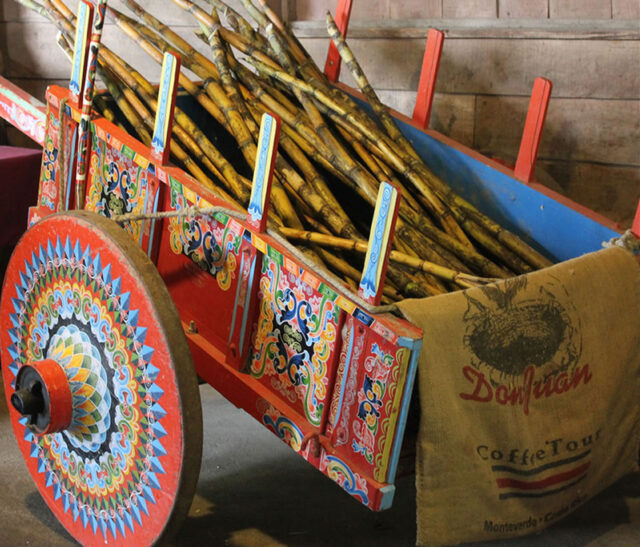
Costarica Sugarcane

As a recent visitor of the ridiculously friendly and ecologically diverse country of Costa Rica, I have to say that I was continuously amazed by how much everyone worked to conserve the environment. I went in knowing that Costa Rica has been the poster child for sustainability and conservation over the last several years, but I was floored by the level of commitment citizens had to the rain forest as well as their own living environments. From having more recycle and compost bins available than trash cans, to keeping toilet paper out of the sewers, to preserving 52,000 hectares (200 square miles) of rain forest and planting more trees than are cut down, Costa Rica’s top priority is sustainability.

Another priority that comes in at a close second is tourism. Travelers from developed countries all over the world feel right at home in the myriad hotels that offer air-conditioning, insect-free rooms, and menus complete with turkey club wraps and chocolate cake. While these hip-and-happening spots are nice every now and then, I’m a fan of diving into local culture and down-home digs.

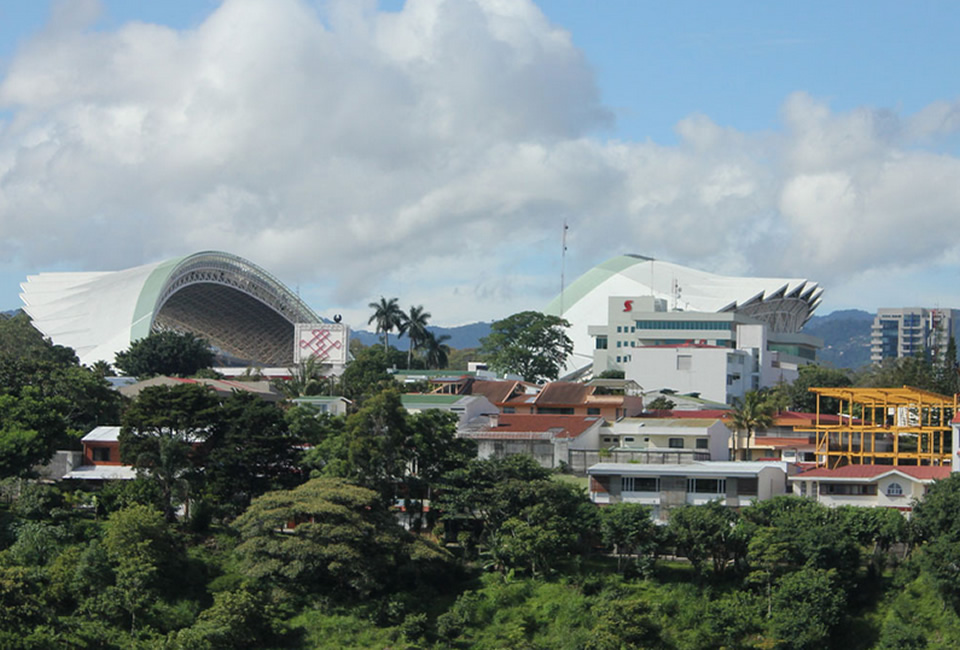
Costarica Stadium
Costa Rica’s brand new soccer stadium, compliments of China

The Evergreen Lodge in Tortuguero came much closer to my comfort zone with metal-roofed huts snuggled in the rainforest alongside a canal. Each morning, we were greeted by the ominous calls of male howler monkeys, who sounded not unlike the Hulk on a bad day. Breakfast, lunch, and dinner consisted of fresh plantains, watermelon, papaya, and pineapple as well as the country’s staple of rice, beans, tomatoes, and a protein of your choice. Activities included kayaking down the protected canals that stretched through thick forested areas. River otters, capuchin monkeys, caimans, spider monkeys, and hundreds of species of birds could be seen from the waterways. Besides taking in the incredible wildlife, visitors could hitch a ride on a boat to the small village of Tortuguero and browse the shops, stick a straw in a fresh coconut, or visit the sea turtle conservatory.The conservatory was one of my favorite places as they would tell you everything you could ever want to know about the local turtle populations. During the egg-laying season, you can join a handful of other visitors to carefully and respectfully witness a turtle lay her eggs in the sand. If you are lucky and patient and have lots of bug spray to ward off the hoard of mosquitos that will inevitably eat you alive, you will see a giant turtle drop dozens of ping-pong-sized eggs into a small hole, then cover them with her tired flippers before creating a decoy nest to confuse predators. After she has worked for two hours, she will haul herself back out to the ocean and you will cheer as the first refreshing wave splashes her in the face.

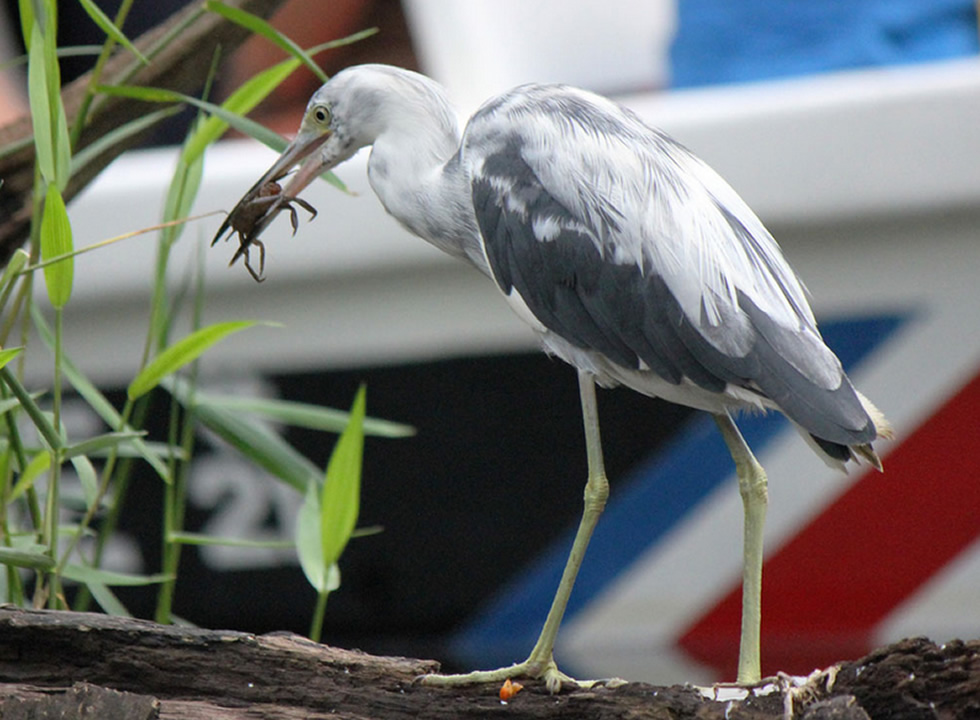
Costarica Bird


Other locations around Costa Rica that are popular among tourists are the volcanic region of Arenal, the mountainous Quaker-settled villages of Monte Verde, and the crammed white-sand beaches along the Pacific side of the country. I was able to visit Arenal and Monte Verde, which offered spectacular views that few cameras can capture, even in the rainy season, (I spent just enough time taking panoramas that people around me started to think I was going crazy). These areas truly are touristy and while many of the lodges are clean and comfortable and equipped with WiFi, I would love to explore other areas that are a little more rugged.

One of the first things I learned about Costa Rica is that they have a favorite saying: Pura Vida. Pura Vida or “Pure Life” can mean anything from “how are you doing?” to “I’m doing great!” to a sarcastic version of “everything’s peachy… not.” It all depends on how it is used. From my experience, if you happen to catch on quick and use the phrase in the right context, you’ll be received with big smiles and a thumbs-up. If you have an American accent, you’ll get a smile and look that translates to, “thanks for trying.”

While this excursion was a personal trip of my own, Immersion Travel will feature Costa Rica’s incredible and diverse regions in upcoming issues. We will showcase many more details about the country including cultural nuances and the best places to get a mouthwatering plate of rice, beans, and chicken tacos. We would love to hear your Costa Rican experiences or help you answer any questions you may have. Drop us a line with Twitter or send us an e-mail.

Pura Vida!

The Five Wise Men of the Voodoo Trail

0
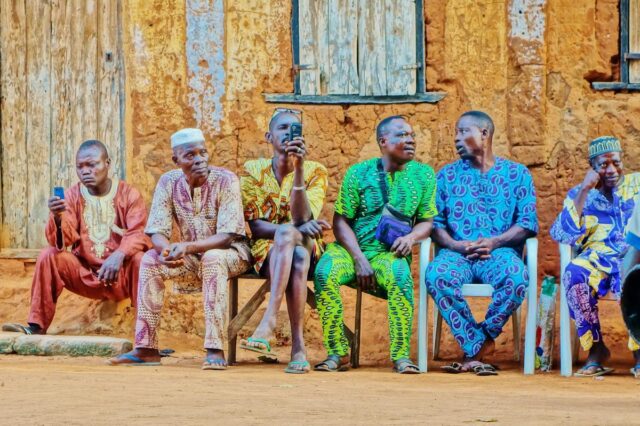
Benin Vodoo Men

The feeling was unfamiliar. Alone, I sat on the splintered wooden bench while the passersby sized me up with skeptical curiosity. Their skin glistened with sweat, accentuating the slash marks lacing both sides of their faces. The slash marks had been deliberately crafted into their visage, haunting me with wonder. Images of celestial snakes and sword-wielding gods decorated the decrepit dwellings surrounding me. This was a faraway world, and for the first time in as long as I could remember as a traveler, I felt the fear of the unknown begin to surge in my veins.

I was in the center of Ouidah, the spiritual mecca of Vodun, immersed in the shadowy culture of voodoo lore. The slash marks were the results of ritual scarification, a tradition in which emblematic scars are etched into the skin as symbolic protection from evil spirits. To an uninitiated outsider like myself, the tattoo-like scars were a bone-chilling ritual from an ancient religion cloaked in mystery and misconceptions.

Understanding its essence had become my travel Holy Grail du jour, and I was willing to explore the depths of its holiest places to discover its truths.

Vodoo Trail

It is known as “voodoo” back home in the States, and its pop-culture perception is saturated with notions of wickedness and awe. It was the native religion of the slaves transported to the Americas from West Africa’s Slave Coast, and it’s been subject to outlaw, demonization, and dogmatic reconstruction since it set sail across the Atlantic Ocean. Voodoo’s associations to witchcraft and evil sorcery were a calculated product of propaganda, a Hollywood production of delusion designed to influence the cultural assimilation/cultural destruction of Africans adapting to life in the New World. Its truths have remained obscure, clouded by apprehensions of fear, hidden behind perceptions of “the other.”

Voodoo exists today in the Americas as a syncretic belief set, producing evolutionary branches of the African religion in Louisiana, Brazil and Haiti. Its roots can be traced to the Gbe-speaking ethnic groups of West Africa, particularly the Fon people in modern day Benin. In fact, the term “voodoo” is derived from the Fon word “Vodun (Vodoun/Voudoun),” which translates to “spirit” in the local language.

Traditional African Vodun remains a mystery to a majority of the outside world. It has survived virtually untouched in Benin, where nearly half of the population practices the animistic spirituality in its purest form. As one of only two countries today (along with Haiti) to recognize Vodun as an official religion. Benin proudly considers itself the birthplace the “Birthplace of Voodoo.”

I wanted to see life through their perspective, and to discover the realities of their spiritual approach to life. A dance alongside the spirits and superstitions of Vodun lore inevitably began in Ouidah.

As one of Africa’s largest slave trade trading ports during the 18th and 19th centuries, Ouidah prospered as an extension of the ruthless Dahomey Kingdom. Following the abolition of slavery and the collapse of Dahomey rule, Ouidah remained a spiritual epicenter for native African religions, specifically Vodun.

Today Ouidah is home to a variety of mystical landmarks honoring its cultural past, such as the Temple of Pythons and the Sacred Forest of King Kpasse. Vodun is not a religion practiced casually; in this part of the world, Vodun is a way of life.

The depth of Vodun spirituality is massive and variations exist within the different ethnic, regional and historical practices, but I’ll briefly explain the basics – as I can best understand them – for the sake of clarity.

Vodun considers itself to be a monotheistic faith, whose primary creator goddess is called Mawu. The existence of a vast pantheon of lesser gods is recognized, each associated with natural forces in a similar structure to the religious pantheons of ancient Greece and ancient Egypt. These lesser gods interact with Mawu on behalf of the spirits on earth, whose relationship with the divine Supreme Being is akin to the heavenly saints and angels of Christianity.

While practitioners of Vodun, known as Vodounci, recognize the entire Vodun pantheon, individuals usually focus their energies toward a select few of their favored deities. Some examples of prominent Vodun deities and the realms of their natural powers include Sakpata (earth/health), Heviosso (sky), Egou (metals/craftsmanship), Legba (masculinity/crossroads), and Dan (prosperity/communication).

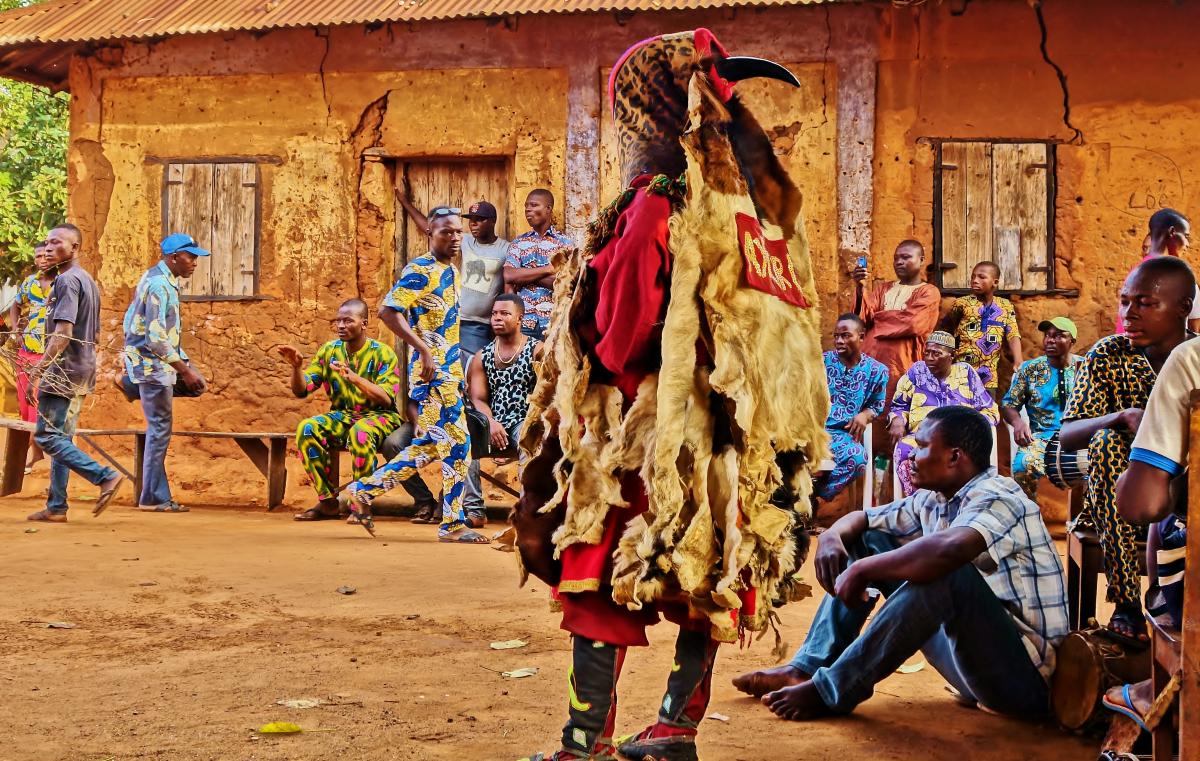
Each deity is associated with a signature dance and drumbeat, and veneration to the gods is expressed by dancing and drumming to these unique rhythms.

Vodoo Journey Africa

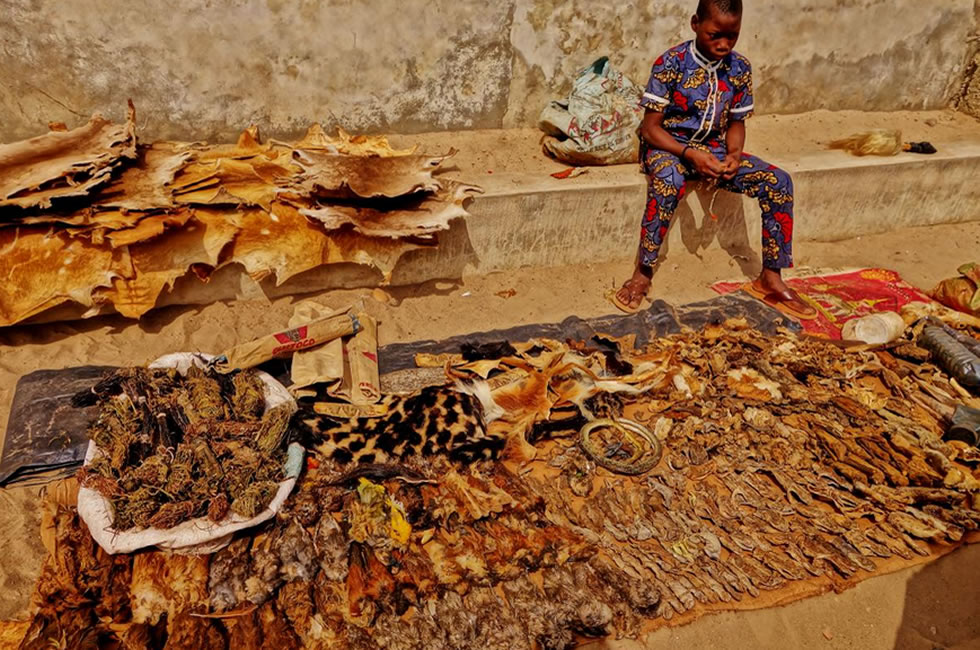
Worship is conducted through ritual interaction with fetiches (consecrated shrines dedicated to the living spirits of Vodun deities and ancestral family members). Fetiches are often makeshift memorials located inside the homes and villages of their adherents, as well as anthropomorphized sculptures of Vodun deities- the historical root of the fabled “voodoo doll.”

Communication with the fetiches usually begins by waking up the spirits through offerings of gin and communal sips of sodabi- a traditional West African moonshine type of liquor made from fermented palm tree sap. Prayers are recited simultaneously accompanied by communication with the spirit world via cowry shells; the shells are rolled like dice and their landing positions are interpreted as direct messages from the Vodun spirits.

These spiritual consultations are orchestrated by a Vodun priest or priestess, referred to as a Vodounon, respectively, whose role is similar to a shaman. These mystical gurus play an important role in their communities for their healing powers and spiritual wisdom, providing insight on health, relationships, justice and the connections to the metaphysical world around them.

The perspective boundaries separating “intensely spiritual” and “obsessively superstitious” can fade into gray at times, but Vodon pulsates with an undeniable reality that everything in life has meaning; every moment is alive.

I had no formal plans beyond finding a seat on that bench that first day alone in Ouidah; I knew it would only be a matter of time before I was approached. I was playing dice with the universe choosing to traverse this continent without prior connections, but like most parts of the developing world, they tend to find you before you find them.

Dressed in a traditional shirt and trousers, known as a Beninese bomba, Odjo walked toward me with a muscular gait and the confident swagger of a man in his physical prime. A local shop owner and proud father of two twin baby boys, Odjo sensed an opportunity. He spoke a decent amount of English – a rarity in that part of the world – and offered to show me around town in exchange for a small fee.

The good fortune of connecting with an English-speaking local with a good pulse on the community cannot be understated; navigating rural Africa would have been impossible without someone like Odjo. I doubled down on his offer, asking Odjo to be my personal guide exploring Benin’s Vodun culture in exchange for a higher price tag. We both recognized the auspiciousness of our chance encounter, and we happily shook hands. Our friendship began in a spark of fortuity and intrigue.

Odjo introduced me to countless Vodun priests and practitioners throughout Ouidah over the next several days. He acted as my guide and translator, mediating conversations between myself and the major players of the Vodun communities. I was less concerned with the dogmatic minutia and more interested in understanding the overarching philosophies of Vodun. I was prepared to start each conversation with a simple two-part question: what is Vodun, and how could it be used to live a better life?

The ethereal world of Vodun would welcome me with open arms.

Agaja came from a village a few miles outside of Ouidah. He wore a traditional blue bomba accented with red and black patches and a cap above his head. His beaded necklaces hung low near his waist, swaying to the slow pace of his strut as he approached me with an ironclad demeanor, seemingly impervious to the highs of delight and the lows of fear. His calmness was contagious as he sat down on the wooden chair in front of me.

“What you must understand,” he spoke in a baritone voice while his eyes looked through me, “is that what goes around, comes around.”

I inquired about the similarities to the concept of karma, but he was unfamiliar with the term.

“What you give, you will receive. What you do to others, will be done to you.”

His hands shot back and forth through the air as he spoke, like a conductor leading an orchestra in slow motion.

“Violence brings more violence. If you use Vodun as a weapon against your enemies, then your enemies, in this life or the next, will use violence against you. You cannot achieve peace through violence. If you want peace, then you must first ask for peace, and then give peace.”

I prodded Agaja with more questions about his subtle reference to the notion of reincarnation and Vodun’s concept of the cycle of life.

“Death is like a comma, not a period. Nature exists in a state of duality, the cycle of life. The sun rises, the sun sets and rises again. The flowers die, become food for the earth and come to life again. Such is life here on earth and in the spirit world. It is the cycle of life, ongoing and eternal. What goes around comes around, so you must live your life accordingly.”

I nicknamed Agaja the Voodoo Buddha, but neither he nor Odjo got the joke. We departed the village and headed further outside of Ouidah, seemingly treading farther back into time.

A grotesque fetiche featuring a pair of horns and a prominent phallus marked the entrance to Glele’s village. This was Legba, the trickster Vodun deity of the crossroads, and similar fetiches placed at the gateways of rural villages were ubiquitous throughout Benin.

Glele was thickly built with broad shoulders, a bulging neck and the bald head of a battering-ram. He liked to wear a live python around his neck like a collar, though his intimidating guise was offset by a jovial demeanor and a hair-trigger smile.

His home featured a large fetiche dedicated to his patron deity Dan, the serpent god associated with communication to the spirit world and believed to endow its adherents with prosperity. My admission was determined by his snake’s reaction to being placed on my shoulders; after Glele had laid its body against the back of my neck, the snake coiled around me until it silently found a position of comfort. I was allowed to proceed.

“The snake alerts me to negative energy; but he seems to like you,” he chuckled as he prepared our shots of Sodabi. He handed me a cup, then took the snake from around my neck and placed it gently back around his.

“Vodun is very powerful, but it is neither good nor bad. It has no intention. It is like a knife, or a spear. It sits still, without emotion. It is you who stabs the knife or throws the spear, who determines its energy.”

The concept of using Vodun as a weapon captivated me. I encouraged him to elaborate. He spoke of an ancient system of justice that predates the legal systems of the modern world.

“Vodun may be used for justice, yes. If another man kills your wife, what do you do? Revenge by your hand would continue in a cycle of violence, so instead, you may pray to Heaviosso, the Vodun sky god and purveyor of justice. Perhaps he strikes down your enemy in a rage of thunder and lightning.”

In a land which has historically lacked the luxuries of an effective criminal justice system, I could understand the practicality of Vodun justice.

“But you must understand, Vodun is not a toy. You must use wisdom. You must have responsibility. You could hurt yourself and hurt others. Just like the blade of a sword, it is sharp, do not play with it like a toy.”

The more he spoke of Vodun, the more he appeared like a Jedi master elucidating on The Force from Star Wars.

“You want to make this girl fall in love with you, Vodun will make it happen. You want to heal this sickness, Vodun will make it happen. You want to grow crops for food, Vodun will make it happen. Whatever you want, the Vodun spirit will give… But you must first ask… And you must use Vodun for positivity only. If you use Vodun for negativity, in a bad way, it will come back to you.”

Glele put the snake back around my neck as I contemplated his words. The snake snuggled up in a comfortable position, and he proceeded with an unexpected question for me.

“So… what is it that you want from Vodun?”

I momentarily went blank, sensing the weight of karma and personal responsibility on my conscious similar to the way the snake had coiled itself around my neck.

“I want to understand… To be able to see the world the way you do, through the eyes of a Vodounon.”

He paused for a moment, silently reflecting on his thoughts, looking at the snake wrapped around my neck. He rolled the cowry shells, mumbled something in an unfamiliar language, then turned back toward me.

“Okay my friend. Vodun shall reveal itself to you.”

Egou (at a Vodun festival)

I took a break from Ouidah for a few days while Odjo returned to his business and family. In the meantime, I explored the side streets of Benin’s coastal highway when Tessi and I first crossed paths. He wore a collared orange and black shirt with shorts and sandals, striding with a hop to his step like he was jamming to a song playing inside his head. He spoke five different languages, including English, much to my delight and conveyed an infectious friendliness about him that was rare in Benin.

He took an interest in my Vodun curiosity upon our introduction, and he offered to help me along my journey simply for the sake of helping.

Tessi was an old soul in a young man’s body. He liked to sit back with one foot resting over his knee, with a habit of extended pauses of contemplation before jolting upright with vigor as his stream of consciousness flowed into spoken words.

Born of a Christian mother and Vodun father, Tessi was considered a Christian at birth. His original name was David. At the age of four, he fell seriously ill, falling into a coma for multiple days before being pronounced dead.

It was at that moment that his aunt, a Vodun priestess, called on the spirit of his deceased grandfather to help bring him back to life. As the story goes, his grandfather reincarnated into David’s body, helping maintain his lifeforce, while his body began to heal. David miraculously survived with a full memory of the ordeal. Later, he formally converted to Vodun, choosing to be called Tessi as his native African name.
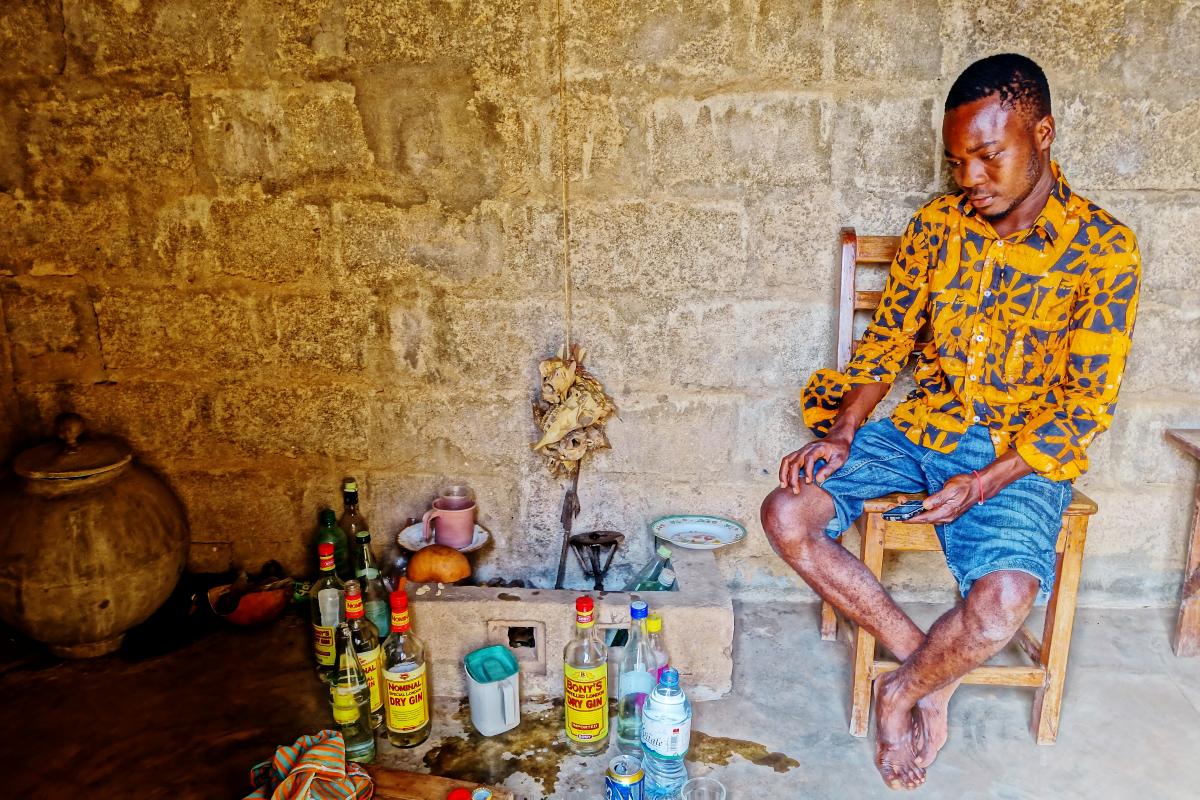
Tessi sitting next to a fetiche

His home had individual rooms for fetiches dedicated to Egou, the warrior god of metals and craftsmanship; Dan, the rainbow-colored snake god, who also served as the patron deity of his grandfather; and Sakpata, the god of the earth with associations to health and wellness.

Tessi’s concept of Vodun was holistic and harmonious.

“We are all connected. We call it the spirit of Africa; the spirit of Vodun, which is the connection. The earth, nature, the living beings, the spirit world; everything is connected. This is Vodun.”

His convictions were strong, and his energetic sense of spirit overflowed as he spoke. In his eyes, there was a sense of meaning to the occurrences of everyday life.

“Everything happens for a reason. It is the way of Vodun. That is why our individual character is so important. How we handle adversity and opportunity; they happen for a reason, and we must embrace the path presented to us. Like when I first met you wandering alone on that street… You may have appeared lost, but no, I knew that you were there for a reason. We are connected, you see…”

I had to give him credit; in a land where corruption is rampant, opportunities are scarce and trust is rare, Tessi was overflowing with enthusiasm and integrity.

But I needed more clarification on the nature of Vodun. Was it an abstract natural force, or did it have a deeper meaning? What was the underlying point of it all?

“My brother, think of it this way… what is the point of music? What is the point of dancing? You see, we are all connected, like the individual notes in the symphony of life. We are all one. So, my brother, go make beautiful music. Everyone that crosses your path is a musical note in the song that is life. Everyone and everything, the plants and animals, the earth, we all must create the melodies to make life on earth like beautiful music. That, my brother, is Vodun.”

Tessi had been born in a hut in a small African village, yet he possessed the wisdom of a thousand lifetimes. He called it “L’espirit d’afrique.” If he does not one day end up as a leader of his country, the world will be a lesser place for it.
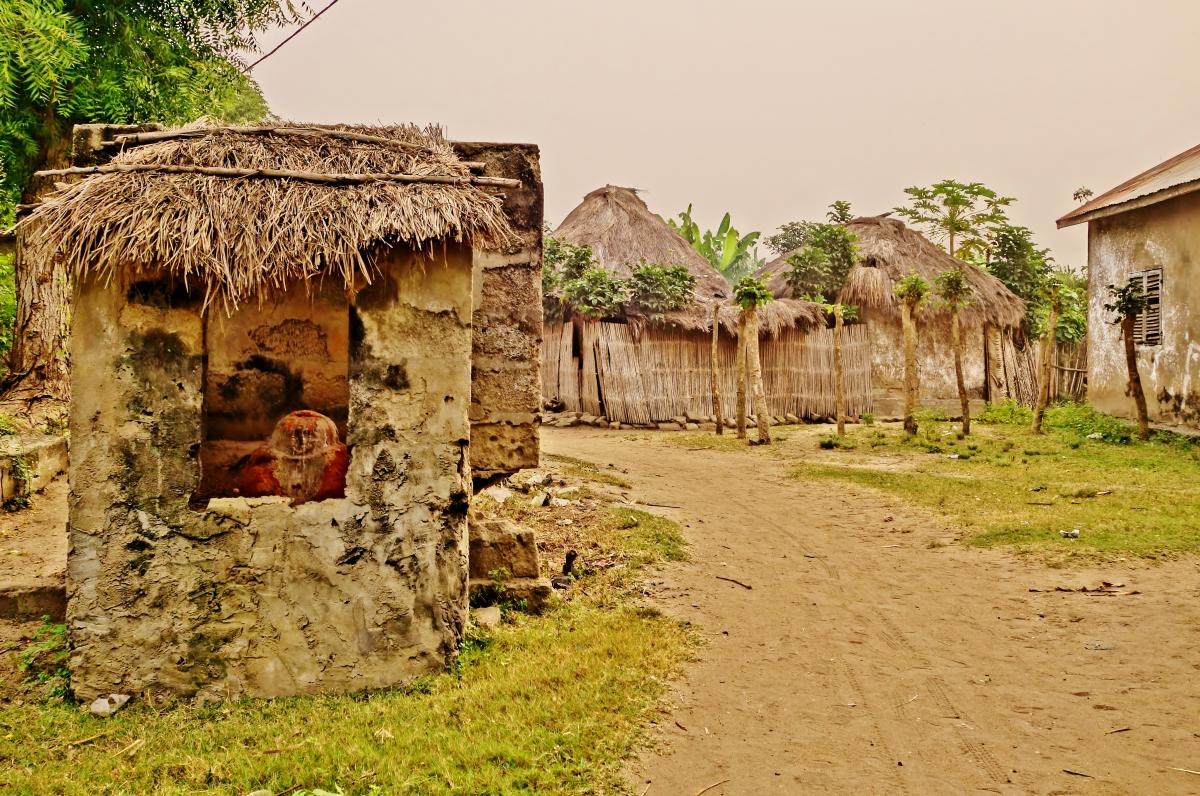
Tessi agreed to take me to a rural African market farther inland and far off the beaten path. We ventured out on his motorbike, following the bumpy dirt roads, which diverged into narrowing footpaths, to a primeval part of the world trapped in an ancient way of life.

The cinderblock walls were decorated with images of an obscure crocodile god; the lone doorway was guarded by a white sheet of linen dancing against the breeze. Otherworldly chanting could be heard from within the the roofless structure. We parked the bike and began to explore, forgetting about the market at which we would never arrive.

Tessi clapped his hands twice, upon which an elderly woman draped in a royal blue shawl appeared at the doorway. Other individuals in similar garb looked on from behind her, fixated on the unusual foreigner, who was clearly in a time and place that he did not belong.

It was an unparalleled moment of serendipity; we had accidentally wandered into a ceremonial gathering of priests and priestesses partaking in a sacred ritual in a rural tobossi-houe- otherwise known as a Vodun “trance house.”
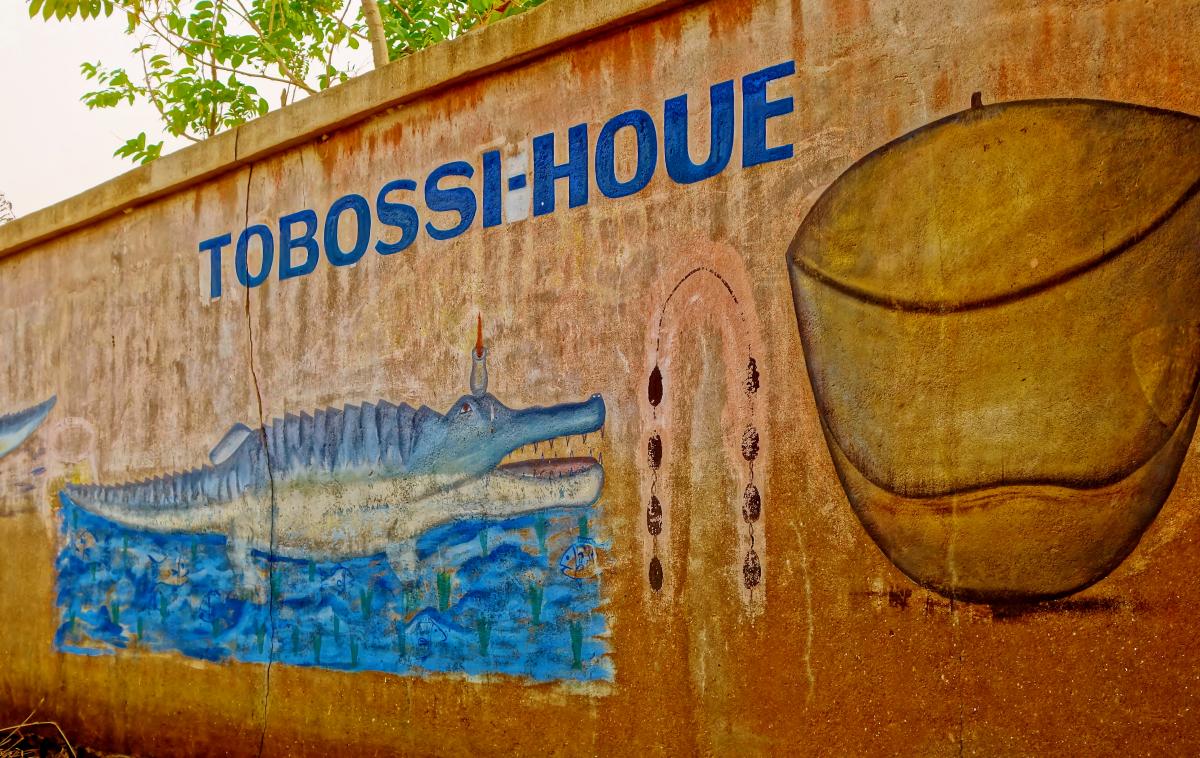
Tessi negotiated our entrance based on his Vodun connections, but not before I rid myself of my western attire and draped a white linen around my waist in a similar fashion to the others. They wore robes of white and royal blue with matching beaded necklaces. Silent feet bearing scars from a lifetime of shoeless labor poked out from under the robes.

The tobossi-houe was dedicated to the spirit of a locally venerated crocodile deity (whose name I never knew). The chief Vodounon was identifiable by his flawless white tunic and a matching cap. He went by the name of Azangli. His presence was commanding, as he stood in silence with a penetrating, unshakable glare.

Azangli lifted his arm in our direction pointing his finger at the ground. It was a signal for Tessi and I to kneel before entering. A woman knelt alongside us and rolled the cowry shells while she spoke to the spirit world. She tapped my shoulder to observe; the cowry shells indicated a positive sign from the Vodun gods. Azangli gave us a dubious nod, allowing us to proceed.

The outer room hosted two life-sized crocodile figures, each dyed green with their jaws stretched open wide. The heads of the crocodiles were freshly covered in blood, remnants of a goat sacrifice from earlier that day. A wooden throne, shaped in the traditional design of the Dahomey kings, sat between them.

Azangli had moved behind the entrance to the inner room, his piercing eyes tracing each of our steps with an apprehensive glare.
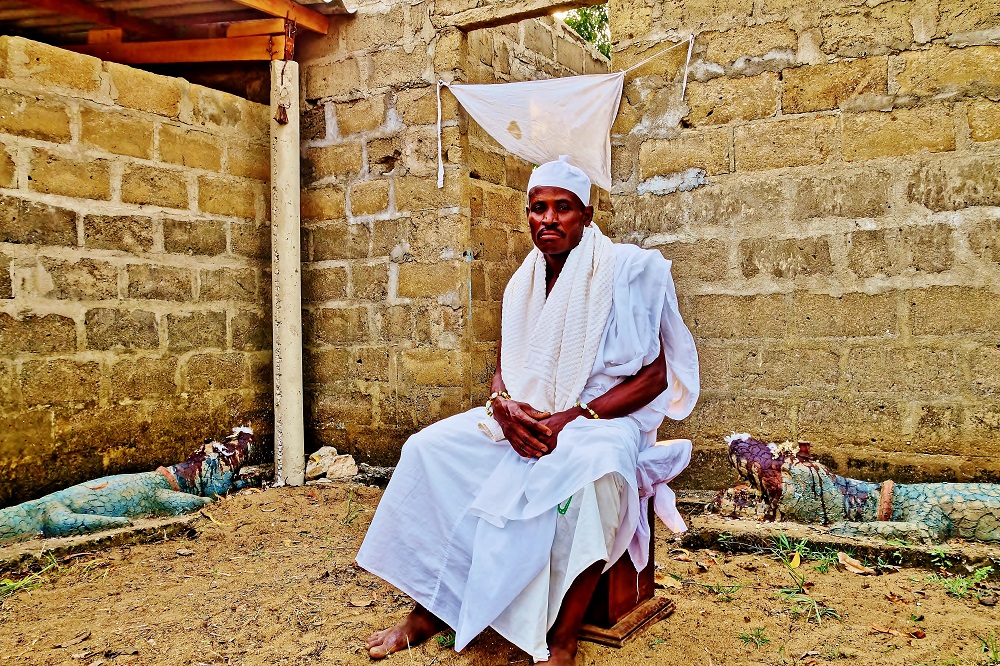
Azangli

The inner room was a sacred chamber featuring a stunning Vodun fetiche unlike anything I had ever seen. A large rectangular altar was positioned in the middle of the room, roughly three feet high and maybe twice as wide. Layers of the skulls, skins, carved wooden objects, ornamented figures, offerings and other fetiche objects sloped like pyramid walls from its sides. Offerings of palm oil and bottles of gin lay close by. Atop the altar sat six crocodile heads; three life-sized carvings crafted from single blocks of wood, alongside three genuine crocodile skulls. Each of the crocodile jaws was open, with a large egg the size of a fist placed neatly at the end of its snout, between the upper and lower front two teeth.

This was the rural community’s holiest of holy sites, their sacred Vodun cathedral, and we had unintentionally interrupted a moment of ritual worship that my eyes were never meant to have seen.

Azangli pointed to the ground with the commanding presence of an emperor, and we quickly kneeled along with the other dozen or so Vodounons in front of the altar of crocodile skulls. He recited a prayer while our foreheads kissed the ground. The rest of the group remained silent.

A silver-haired woman wearing only a blue shawl around her waist handed me the bottle of sodabi. She moved about with the aging grace of royalty, appearing to be the high priestess of the sect; the spiritual queen to Azangli’s king. Tessi and I each took two sips, the first for ourselves, and the second to be spit out directly at the foot of the skulls.

She knelt before the altar and rolled the cowry shells to determine the fate of our visit. Azangli sat on his throne in silence while he anticipated the message of the gods.

She gave him a nod while she recited a prayer of gratitude in the Fon language. He returned the nod in our direction, speaking directly to us for the first time.

“You have no negative energy, and the Vodun spirits have welcomed you,” he said in a sonorous voice that echoed with a charismatic gravitas fit for a king.

I was overcome with a mix of euphoria and relief. I looked back at Tessi to see his face lit up with a confident “I told you so” shine in his eye.

“What is it that you want?” Azangli continued. “Answer me, and we shall pray together.”

Azangli’s question was literal, and he expected a precise answer. The Vodounons stared back at me in silent curiosity as soldiers of Azangli’s spiritual realm.

For a moment in time, all energies possessed by the Vodounons in the tobossi-house would be focused on the subject of my request. That my wish would be granted was taken as an absolute certainty.
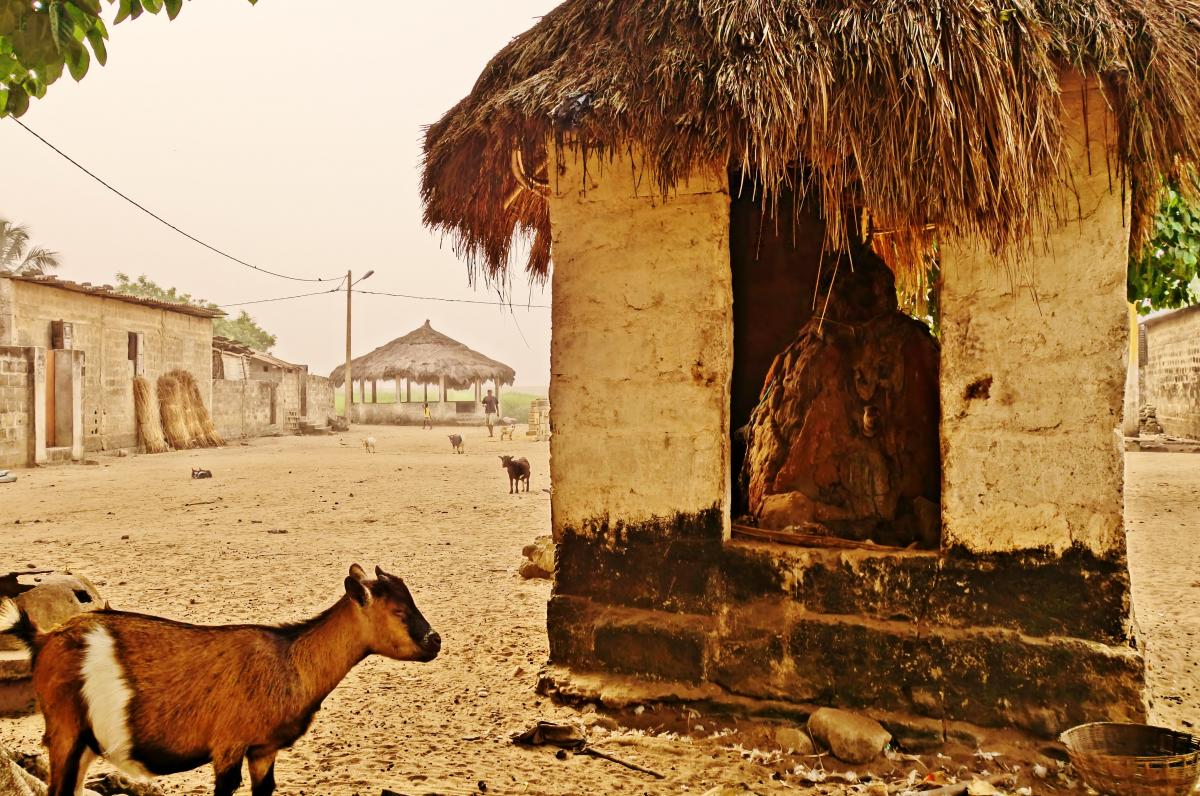
It was the law of attraction; ask and you shall receive. Azangli sensed my ignorance, switching roles from monarchical sorcerer to Jedi philosopher; he was the human incarnate of Yoda crossed with Professor X.

“If you want money, you will receive it, but you must help others who are poor. If you want food, you will receive it, but you must feed others who are hungry. If you want health, you will obtain it, but you must help others who are suffering. You must return to Benin to pay your respects, so you can share the blessings with the Vodun spirits.”

Vodun manifests itself like esoteric magnetism; it rewards humility and punishes hubris. Pay it forward, show gratitude, and the positive energies of Vodun would guide me to prosperity. Act selfishly or wish harm to others, and I would be punished to the identical degree.

The Vodounons circled around the room and knelt before Azangli, their hands held together solidifying an impenetrable ring around the altar. I knelt alone at the foot of the crocodile skulls with Azangli directly to my side. He sat on his throne and bellowed a prayer to the spirit world while the high priestess showered the crocodile altar with offerings of gin and palm oil.

The Vodounons were synchronized in rhythmic chanting in between deliberate pauses from Azangli. I kept my eyes tightly shut with my forehead buried in the dirt floor, internally balancing the flooding sensations of gratitude and awe. I tried to breath slowly and soak in vitality of the moment. Time and space stood still as my ego momentarily vanished, only to return instantaneously with the unmistakable feeling of deja vu.

I raised my head to wipe the dirt from my face. The high priestess handed me a communal cup of sodabi, formally ending the ceremony. Azangli granted me a silent nod of approval while I stood on my knees, eye to eye with the jaws of a crocodile skull. I was offered a bowl of cassava and goat innards, and I politely chomped away at the rubbery flesh. Azangli appreciated my efforts, finally cracking a smile.

He offered me a single photo upon my exit, a solo portrait of himself on his throne. Then Tessi and I began our slow journey back towards the modern world.
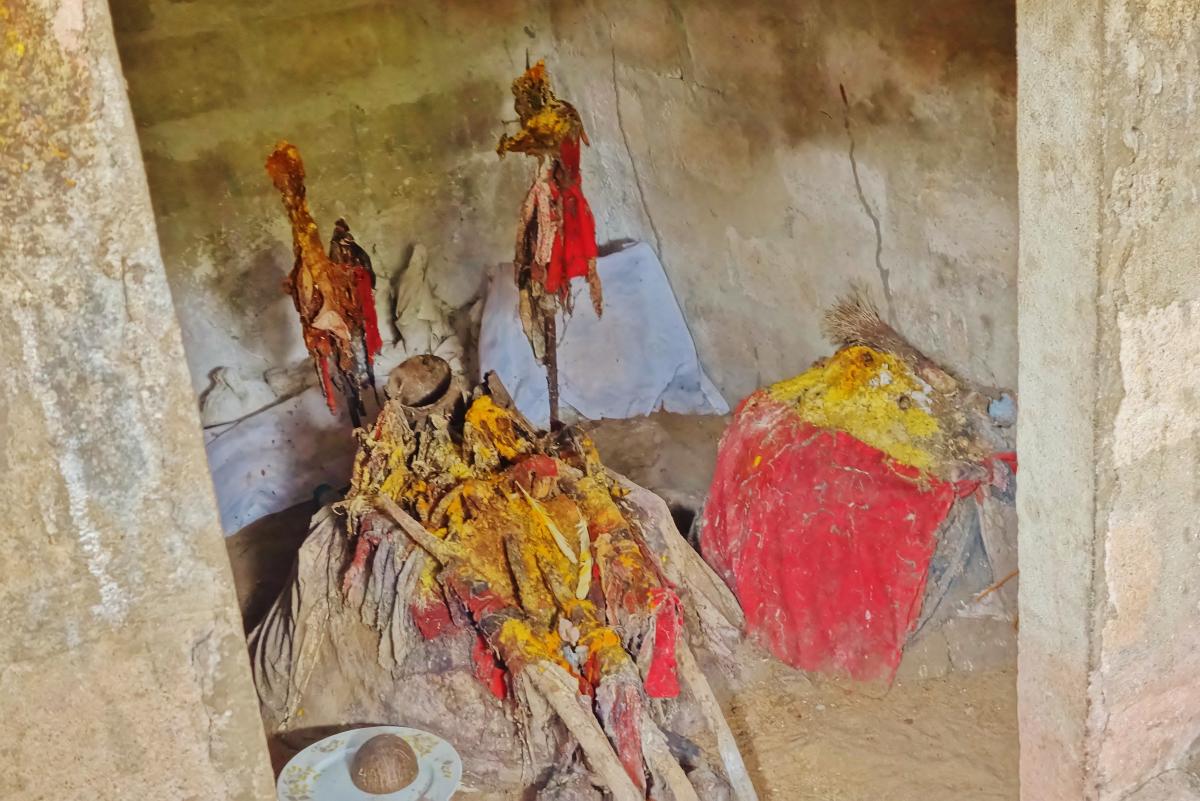
 

Odjo had been awaiting my return to Ouidah. He had arranged for me to meet a highly revered Vodounon, assuring me that all of my questions about Vodun would be answered.

Zomadonou’s home was located down a dirt road extending inland from the outskirts of town. He was tall with a sinewy frame and gumby-like arms and legs, topped by a white cap similar to a Muslim taqiyah. He moved about with bolts of energy from the base of his spine, constantly veering in roundabout directions as his attention shuffled between thoughts like a mad scientist.

He welcomed Odjo and I with a toothy smile and a handful of cowry shells; a few rolls of the shells eliminated any further hesitations: Odjo and I were meant to be there.

“The power of Vodun is like the power of the sun,” he spoke with his palms open and arms spread outward, strategically tweaking his voice to emphasize his points.

“Just as the sun gives energy to life on earth, Vodun gives life to energy on earth. It is the connection of life and energy, the duality.”

I asked about the similarity to Yin and Yang, but was met with a blank stare. The abstract philosophy was enchanting, but I wanted to understand its practical application.

“All living things consist of energy; this energy comes from the same source. Like sun rays that come from the sun; separate, but at their essence, the same. Vodun is like the sun, and we are the light… So, we must shine.”

This prehistoric animistic religion sounded remarkably like new age philosophy. I began to wonder if humanity’s approach to spirituality may be coming full circle from the time of the ancients.
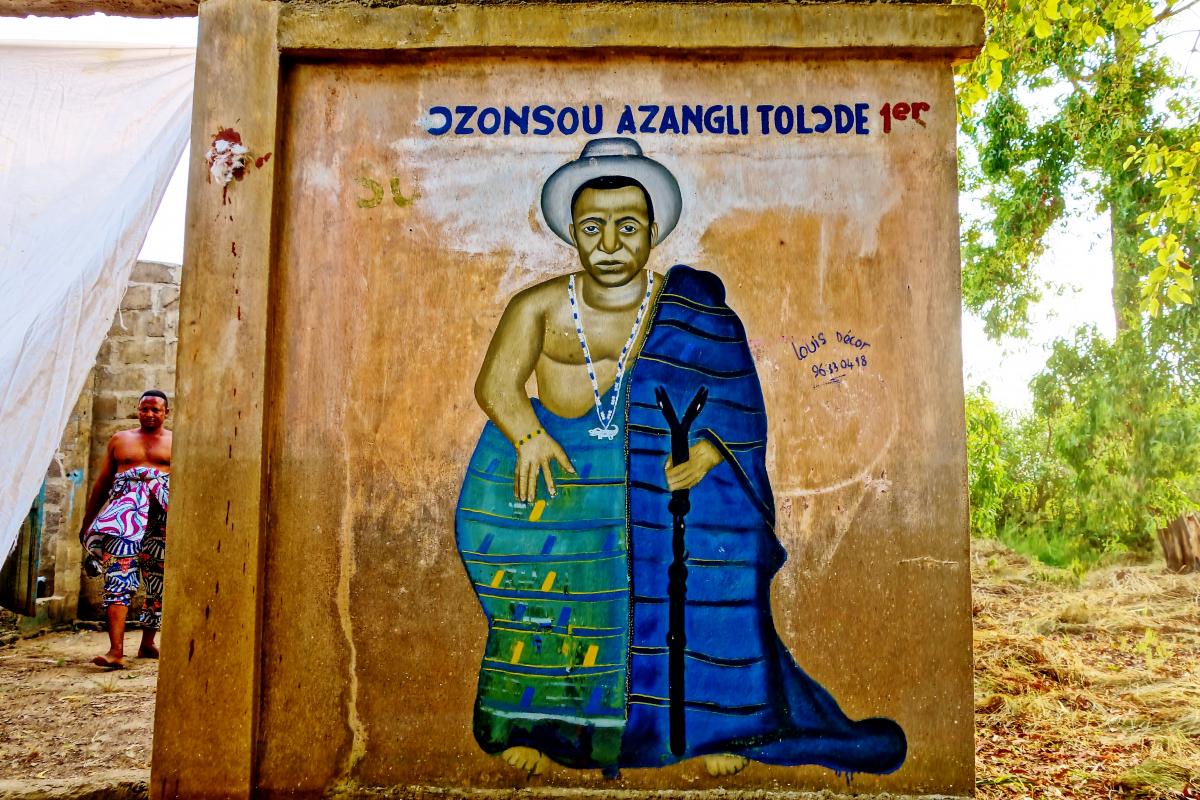
I wanted to know more. Could an outsider like myself harness the powers of Vodun?

“Vodun… You cannot touch it… Like light, it has no shape…” His hands maneuvered through the air as if he were sculpting his thoughts from an unseen block of clay.

“It begins with the state of your mind. Your mind creates your thoughts. Your thoughts become your behaviors. Your behaviors create the state of life on earth. So, the state of earth is a reflection of your mind. When the earth is suffering, it is a reflection of the mind of the people.”

The emphasis on the connection with the energies of the universe was evident, the role of positivity undeniable. But, the stigma of malicious evil spirits remained. The ritual scarification only seemed to intensify this fear, and I could not understand its practicality. I began to point to the scars and ask, but Zomadonou remained one step ahead.

“You do not understand the forces of evil spirits, because you cannot see them. The Vodun scars help us to see them; they know that we are watching. We defeat them with our mind.”

I had ventured too far into the deep end, and was no longer able to keep up. My face must have reflected my confusion, as Zomadonou sensed my optimistic curiosity beginning to sour. He slyly turned his attention to a handful of cowry shells. Lighting a candle while he had a word with the spirits, he rolled the shells two times, then looked back at me.

“I can cleanse you of the evil spirits, if you want, but first, you must ask for it yourself. Your Vodun power will be revealed to you.”

I wasn’t sure exactly what that meant… But how could I say no?

I looked at Odjo, who gave me a nod; I returned the nod to Zomadonou.

“We will have a Vodun ceremony for you. To cleanse you of negative energy and evil spirits. The Vodun spirits give you protection, show you Vodun powers, now and in the future.”

I could feel the universe laughing at me once again. I had wanted to learn about Vodun from the perspective of its most spiritual adherents, and here I was, in the back alleys of Ouidah, with the opportunity to have a powerful Vodun priest perform a ritual ceremony to conquer evil energy and reveal the Vodun powers of my own inner spirit.

I was ready to go all the way.
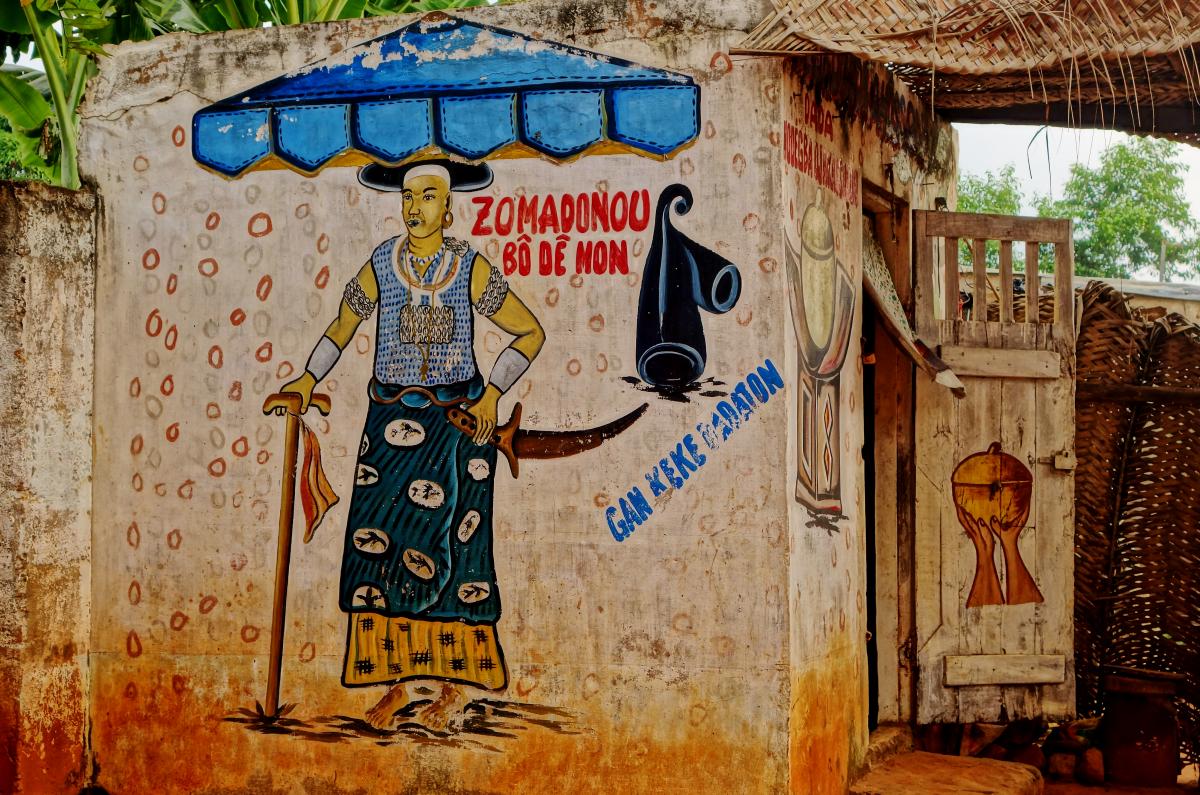
I wore a white linen cloth over my teal Beninese trousers, no shoes or shirts allowed. The outdoor courtyard behind Zomadonou’s home featured conglomeration of peculiar fetiches laid out on a mat. The fetiches were covered in a messy blend of dust and dried blood. Their specific purpose remained unknown.

Zomadonou and I kneeled in front of the fetiche while he rolled the cowry shells and recited a prayer. Odjo and other locals had gathered around us as spectators, their eyes dancing with fervor at the site of a foreigner, who they began referring to as their brother.

A young girl handed Zomadonou two live chickens.

He held the chickens upside down, as if their legs were handles. A groundswell of fear consumed me once again; suddenly I knew what was coming. I had yet to witness ritual sacrifice as part of a Vodun ceremony, and I had never ever expected to be an active participant. The feeling was unnerving, but I had to respect the cultural norms; I was a guest in his home, and they were not my rules to reform. I looked into the chicken’s eyes and apologized from within.

Zomadonou traced the chickens over my body like a metal detecting wand, reciting a prayer in the Fon language throughout the process. Using a sanctified knife designated strictly for ritual sacrifice, he cut their throats one at a time and dripped the blood over the fetiche in absolute silence.

It is during these moments that the Vodun spirits manifest on earth, deriving strength from the blood of the sacrifice, and performing the divine miracles of Vodun lore.

In my case, that meant a spiritual cleanse of evil and negative energy, with the hope that my so-called Vodun powers would become actualized. Zomadonou again began to speak aloud to the spirits, while the chickens ceased to suffer no more.

The next step was a purification bath. Across the courtyard was a barrel filled with sanctified water and freshly gathered plants, whose mixture had been specifically formulated for my individual ceremony. I was instructed to drench myself completely in holy water using the vines that had been soaked inside the barrel. It was a cleansing in the most literal sense, and I was given my privacy behind a white curtain hanging from clothesline in the courtyard.
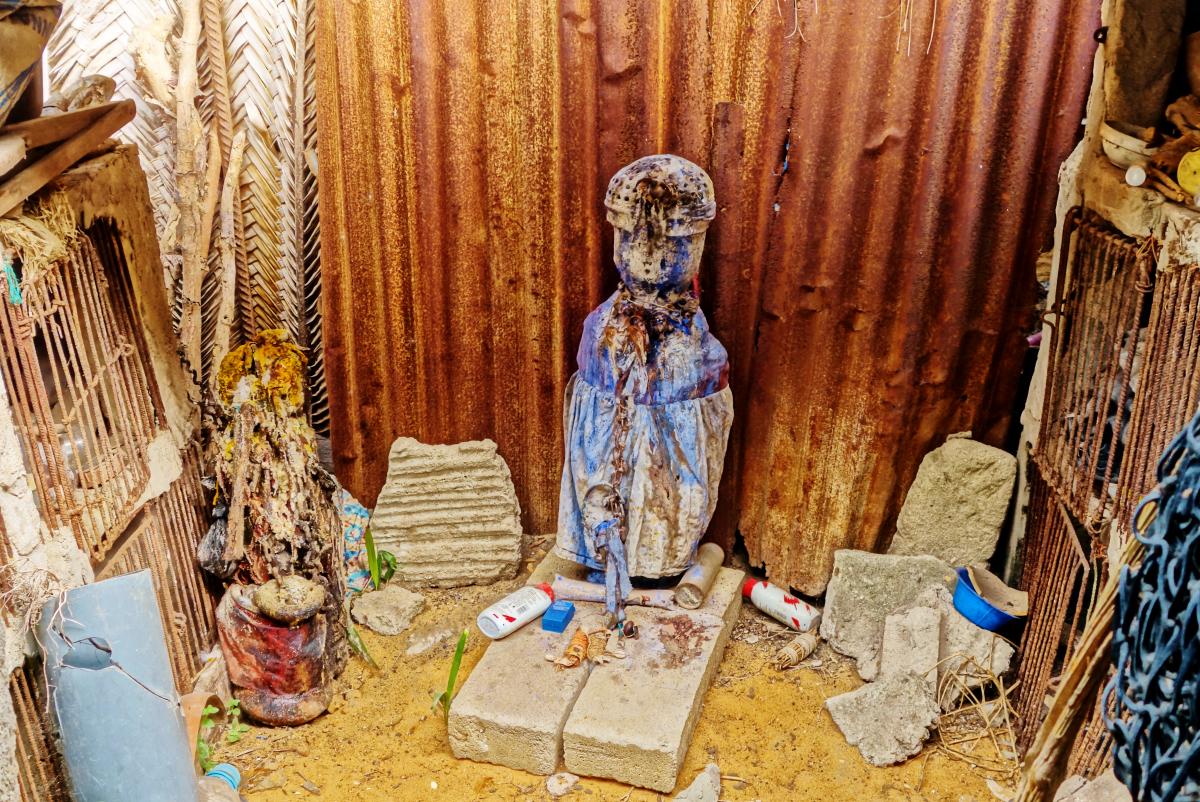
I returned to the fetiche mat and slowly took a seat on a stool placed near a circle drawn from flammable black powder. Zomadonou crouched next to me and placed a cup of dark powder on the ground.

He opened the palm of his hand to reveal an unopened razor. Zomadonou slowly unwrapped the razor’s packaging while giving me a nod. My jaw clenched to a petrified state. My voice failed me as my hand defensively shielded my face.

Ritual scarification on my face was a line I would not cross.

Zomadonou laughed at the weight of my trepidation and turned his attention to the village children, who looked on as eager spectators just a few yards away.

“We no longer cut our faces; look at the children.” He said in a confident tone.

It was an observation that I had missed entirely. The faces of the children were clear and unblemished.

“Now we make the cuts very small… around the body,” he said as he waved his hand in a circular motion to my chest and shoulders.​

I stared at the razor blade as my heart began to beat with the intensity of an African bongo drum. I took a deep breath and accepted the unknown outcome of my fate… there would be no going back.

He cut me twelve times; six pairs of small incisions on both shoulders, both sides of my torso, my chest and my back. The small slash marks were painless, the trails of blood were minimal.

Zomadonou quickly rubbed the chalky mixture of soot-like powder deep into the open wounds, chanting to the gods. The powder instantly transformed the cuts into tattoos, solidifying their permanence and enhancing the visceral effects of scarification.

I felt no pain.
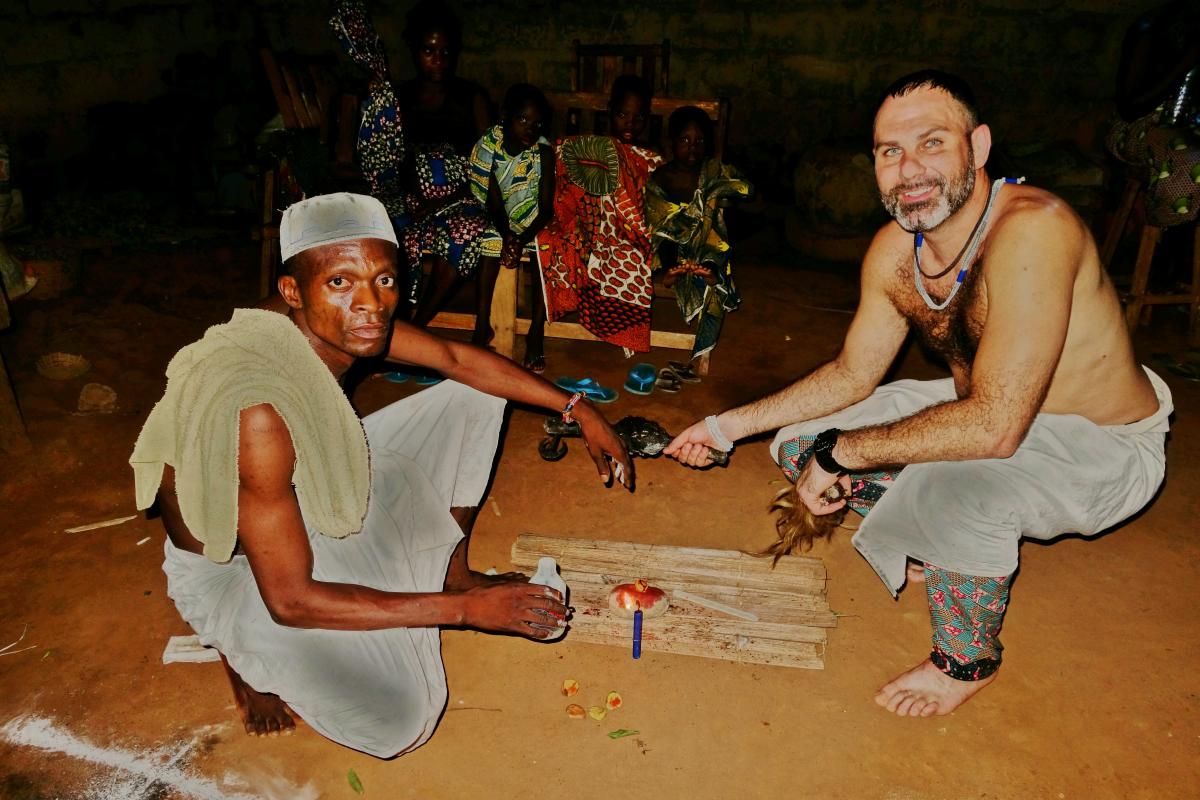
The cleansing ceremony with Zomadonou

We broke from the formality of the festivities to share an evening meal with the local community. The growing darkness of night consumed Ouidah as we broke bread together.

We returned to the outdoor courtyard and immediately consulted with the spirits. Situated before us was a fetiche-sack crowned with the heart of a chicken and soaked in scented oils and sacrificial blood.

I positioned myself directly inside the flammable black circle while Zomadonou called out to Sogbho, a potent sky god of the Vodun pantheon associated with the power of explosives. I cradled the fetiche-sack in my hand and balanced the chicken heart on the surface. I extended my arm outward toward the stars.

Zomadonou put a match to the base of the circle, its outer edge igniting in both directions. He shouted at the nighttime sky as I held the fetiche steady with the focus of a sniper.

The onlookers were spellbound by the blazing circle of firecracker powder and booming Vodun oratory. Zomadonou’s arms thrashed through the smoke and shadows like an inflatable tubular air dancer, enhancing his grandiloquence in a cinematic fashion.

The fire burned out as Zomadonou’s words tapered off. The fetiche remained steady; the heart did not fall. The audience roared with approval. Zomadonou confirmed that Sogbho triumphantly cleansed all negative energies and evil spirits from within me.

He took the fetiche from my hand and led me into a shadowy crypt-like chamber at the far end of the courtyard for one final task.

He lit the chamber with scented candles, illuminating the carved wooden figures of Vodun gods and the sacrificial offerings of past ceremonies. We knelt before a small altar positioned against the center of the far wall.

Zomadonou tactically moved the candles and fetiches along the edge alter. He rolled the cowry shells, crooning with the spirits one last time. He handed me a cup filled with dark powder, mixed it with soda, and instructed me to drink it all.

I had never come across any information regarding this type of ritual during my pre-trip research, and thoughts of its potentially harmful effects swirled through my head with the uprooting force of a tornado.

When I asked what it was, the only answer I could get was “Vodun drink… so the Vodun stays with you.” Hey pointed to his gut before extending his finger in a circular wave around his body.

I wrapped both hands around the cup, held it to my lips and contemplated my fate. This was uncharted territory.

The Holy Grail scene from Indiana Jones and the Last Crusade flashed in my mind; his quest for knowledge of the divine had taken him through the depths of legends, until he held the cup of Christ in the palms of his hands.

The stakes were a far cry from the fate of mankind, but nevertheless my moment had come. I had asked for knowledge of Vodun, and the final challenge now similarly rested within my own two hands. The allure of this ancient knowledge was irresistible.

I took a deep breath as I took one last look around the room, the shadows of Zomadonou and the fetiche statues waving in the flickering candlelight of the crypt-like room. I shut my eyes, tilted the bottom of the cup to the pitch black ceiling, and let the Vodun drink flow deep inside of me until every last drop was gone.

It was surprisingly smooth, and it tasted like candy. I gradually opened my eyes, letting it all settle, slowly breathing in the tranquil fragrance of the scented candles.

I felt great.

I looked around the room, momentarily fixated on the reflections of light dancing against the scars and the smile adorning Zomadonou’s face. My own smile reflected his, and we started to laugh alongside each other.

My hands no longer trembled. The muscles around my neck loosened up. The tightness in my back relaxed.

The fear that had consumed me since that first moment in Ouidah began to melt away, until it evaporated completely. I was quickly seduced by a feeling of illumination, swept up in a profound moment of clarity.

The concept of evil was symbolic; the evil spirits had been a metaphor for fear.

The scarification served as an esoteric vaccination against the malaise of fear. The ring of fire signified its metaphysical crematorium, incinerating the clutches of fear in a grandiose public execution.  The ritual cleansing was a metaphorical polishing of our inner shine.

It all clicked.
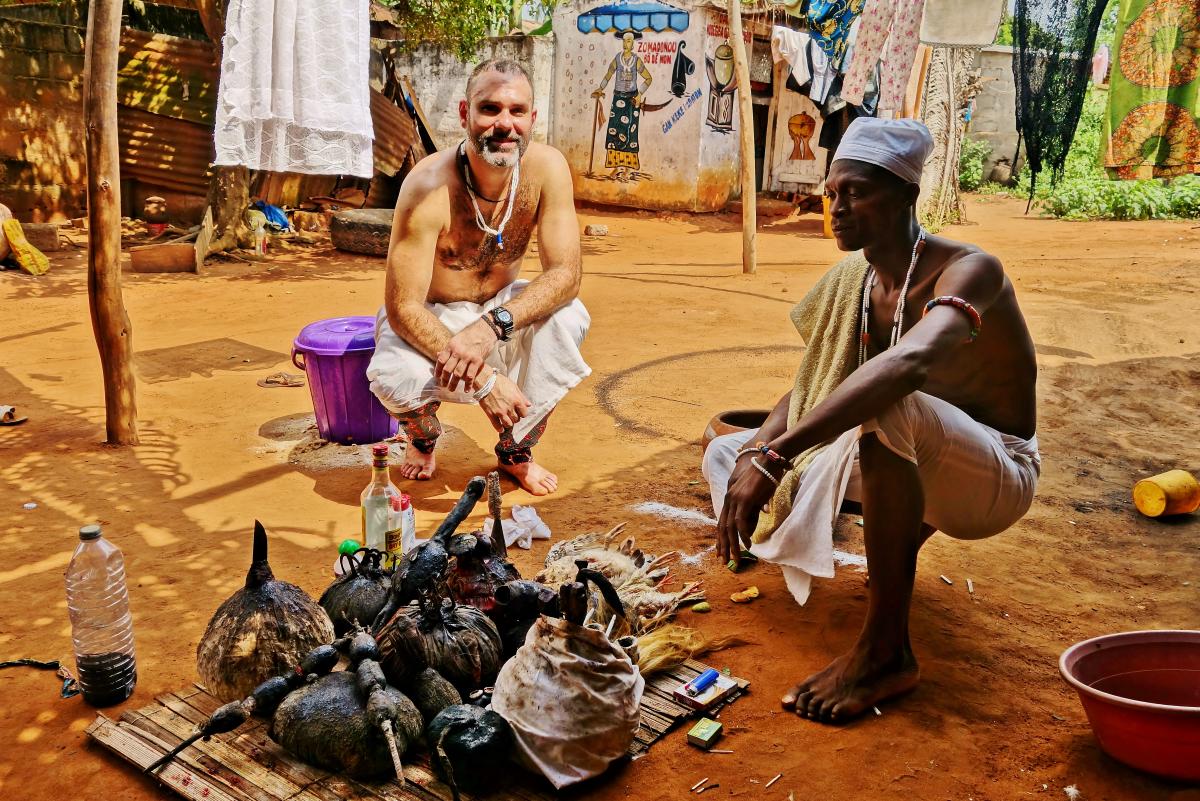
Fear, particularly fear of “the other,” has divided humanity since the beginning. Fear prevents us from connecting. The evil spirits that have plagued the unity of the human race were never an external force to be battled with swords and superstitions; they were a force from within, an individual blemish on the universal consciousness of the human spirit.

United we stand. Divided we fall. It all became perfectly clear.

Zomadonou’s sacred chamber turned to complete darkness as he blew the candles out, but only then could I finally see the light.

So, what is Vodun?

Vodun is a dazzling expression of ancient superstition and new age spirituality, which sees all life in the universe as a connected natural force.

It is Buddhist karma crossed with The Force from Star Wars; an impartial power of the Law of Attraction traveling a circular path through the cycle of life.

It is the prehistoric science of the natural world; a polytheistic system of divinity, reason, and justice; an omniscient answer to the mysteries of life.

It is the sound of music; the harmonious vibrations that flow from the rhythms of our mind.

It is the spiritual companion, the Yin to the Yang, of the life giving energy of the sun.

It is the organic energy which connects the physical and metaphysical realms, and it exists within us all. It can be influenced at will, by those keen enough to understand the nuances of its vitality; it is “the vibe.”

It is the universal divine spirit, known by many different names in many different cultures across the globe and throughout history; whatever you want to call it is ultimately up to you.

I had one final question for Zomadonou about the nature of my soul and the spirit of Vodun; I had been exposed to so much on this crusade, and I was trying to sort it all out.

“I want to know – this adventure to Africa and my whole experience with Vodun – Did I choose Vodun and create this journey myself, or did Vodun create this journey and chose to take me along for the ride?”

He sprang up from his seat in a eureka-kind of moment, put both hands on my shoulders, and flashed his omniscient grin. Looking me straight in the eye, he began to answer. I should have seen it coming.

“… Yes.”

The following day I hitched a ride down West Africa’s coastal highway, en route to Farafina’s seaside Rasta beach in Grand Popo. I wanted a place to relax and reflect on it all, and sure enough, I found an empty hammock hanging from a palm tree waiting for me on the beach. The lyrics of Bob Marley echoed from a bar in the distance…“one love, one life…” As they say in Benin, “la vie est belle.”


Immersion Trave…

Timeless Pleasures in Sicily

0
Sicily Town

Sicily is the biggest island in the Mediterranean Sea and a true open air museum showcasing more than 260 ancient archeological sites such as temples, amphitheaters, fortresses, towers and churches. To add to the splendor, a crystal clear sea frames the island and its treasures.

In December 2015, I accompanied my parents on a week-long trip to the eastern part of Sicily. We wanted to spend the holidays away from our surprisingly foggy home in Florence, Tuscany, and Sicily turned out to be the perfect escape.

Even though we had already traveled to Sicily a few years before, this trip was intended for us to discover a completely different side of Italy. Due to the invasions of Roman, Vandal, Byzantine, Islamic, Norman, Catalan and Spanish armies since the 8th century BC, the region now reflects the cultural nuances that each group left behind. In just one city, you can find Arabian palaces, Baroque churches, Roman amphitheaters and Grecian theaters.

Caption: The Greek theatre of Taormina

This timeless fusion of culture can best be seen in the town of Taormina, where we decided to begin our Sicily adventure. Here we got lost in the boutique-lined main streets and medieval narrow alleys, where the branches of orange trees and oleanders leaned out from private residences. When we arrived at the town’s main vista covered in cactus and surrounded by jagged cliffs, the balcony of the Piazza IX Aprile offered a stunning view of the sea and Mt. Etna. White puffs of smoke rose from the volcano’s snowcapped edges and into the blue sky. In the square, we were surrounded by the splendor of Saint Giuseppe church, Saint Agostino church (now a library) and the Torre dell’Orologio balustraded clock tower. The tower seemed a gateway to another time as its delicate archway welcomed travelers to the older neighborhoods of the town.

It is not a coincidence that writers have extolled Taormina’s beauty almost since it was founded in the 6th century BC. The more streets we strolled in Taormina, the more bucolic it felt. Cafes with outdoor spaces and local specialties speckled the city center streets. We loved the harmonious fusion of medieval, renaissance and baroque architectural styles. Nearby we could see Giardini Naxos, the first Greek colony in Sicily in 735 BC. The colony was a subtle reminder of the changes that the town had seen. My parents and I found that Taormina embodied the passion, the sophistication and rustic warmth of the Mediterranean. For my mom, Taormina was like a fresh floral perfume. For me, the city’s atmosphere was vivacious and radiant with the fusion of ancient styles laced in a delicate femininity. It wasn’t hard to see how so many had fallen in love with the area and why they didn’t want to leave.

Caption: Baroque style domintes the Valley of Noto

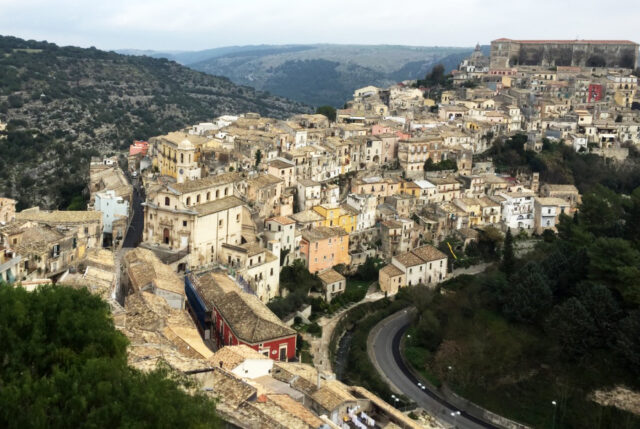
We continued our Sicily trip from Taormina to the Baroque valley of Noto. The valley forms part of a UNESCO heritage site and includes the cities of Caltagirone, Catania, Militello in Val di Catania, Modica, Noto, Palazzolo Acreide, Ragusa and Scicli. Small settlements perched on hilltops, their golden monuments glowing with the Sicilian sunshine, could be seen from miles away. These cities were meant to be seen, celebrated and adored. This tiny but opulent Baroque jewel is the result of the efforts to rebuild after a devastating earthquake in 1693. In Noto in particular, the atmosphere felt like a luxurious treat. In a region populated by olive and almond trees, it sits on a plateau dominating the valley of the Asinara and its citrus plantations. We enjoyed driving our car through the valley and admiring every nook. Each site seemed an outstanding testimony of the exuberant genius of late Baroque art and architecture.

Caption: The Valley of Noto

The richness and the sensuality of Sicily is not limited to its monuments or natural attractions. The freshness of the local tastes and the gastronomic varieties make the island a must-experience destination, and for that, we specifically visited the Baroque town of Modica, the home of a very special chocolate. The story of Modica’s chocolate goes back to the 16th century when the Spanish introduced cocoa seeds from Mexico to the region, which was then considered to be the most economically and culturally influential part of the Kingdom of Sicily. Regarded as a source of strength, vigour and a sign of wealth, chocolate became popular among Modica’s citizens and is still prepared today using the traditional Aztec method. Modica chocolate has remained unchanged through the centuries and has never become industrially produced. I couldn’t resist chocolate tastings offered by some of the tiny food shops in the town, and I was pleasantly surprised.

Caption: A Mpanatigghi from Modica. Photo credit: Pond 5

My curiosity on the subject was satisfied by the owner of a local gelateria selling Modica chocolate. With typical Sicilian pride and warmth, he explained to us that, unlike common chocolate, the mass of semi-ground cocoa mixed with castor sugar and cinnamon or vanilla is kept at cold temperatures that prevent the sugar crystals from melting. I was in love with this chocolate: it had a rough and dull look on its surface with visible sugar grains, a crumbly consistency and the shine of a polished marble inside. The strength of this product is the simplicity of the technique and the fact that there isn’t additional butter or other extraneous substances. For me, Modica chocolate represents the essence of Sicily: a rustic, luxurious and tasty gem. To quote Leonardo Sciascia in La Contea di Modica, “the flavour of Modica’s chocolate is so unique that whoever tastes it seems to have arrived at the archetype, the absolute, and the chocolate produced elsewhere – even the most famous – seems to be an adulterated or corrupted version.”

During our visit, I also had the pleasure of discovering another interesting Modica tradition: the so-called Mpanatigghi. The name was created from the phonetic distortion of “empanadas.” Along with cocoa seeds, the Spanish brought empanadas to Sicily in the 16th century. Sicilians made their own version of it years later. These half-moon shaped cookies have a thin crust and are filled with sugar, bitter chocolate, almonds, lemon, eggs, cinnamon and vanilla, as well as a secret ingredient: minced beef… That’s right. Beef is in these cookies for chocolate lovers of all kinds, like myself!

Caption: Pasta with fresh tuna, mint and tomates served in a sea shell

If a foreigner asked me where to travel in Italy, I would undoubtedly suggest Sicily. The beauty of its beaches, mountains, hills and archeological sites surely put Sicily on a traveler’s radar, but beauty alone doesn’t do the trick. What entices travelers to the island is the food – the best culinary traditions of the world. My parents and I, although coming from another Italian paradise, Tuscany, agreed on this: the charm of the Sicilian countryside, the variety of seasonal fruits and vegetables, the freshness of fish and meats and above all, the way such food is prepared, is unique. It amazed us to learn how Sicilians have continued to follow recipes acquired from ancient invading cultures. Such a cornucopia of contrasts made us truly fall in love with this land.

Article and photos by Giulia Grazzini.

Tattoos & Mangos

0
Tattoos and Mangoes

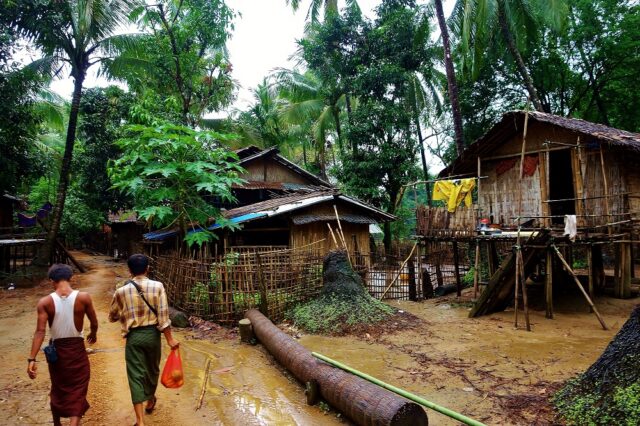
The dark lines of ink covering her tattooed face couldn’t dissuade eye contact, and for a moment, we both caught each other staring. The woman’s stretched earlobes dangled under the weight of her circular earrings, intensifying the patterns of tribal tattoos emblazoned on her skin. I almost couldn’t look away. She held a mango in one hand and pointed directly at me with the other, signaling for me to kick the mud off my sandals before climbing up the steps into her bamboo-stilted, thatched-roof home.

Firmly entrenched in her golden years, Hla is one of the last tattooed women of the ethnic Chin villages in Myanmar’s remote Rakhine State.

A local custom with origins shrouded in centuries-old lore, the practice of applying tattoos over the faces of native women apparently began as a tactic to disfigure women’s natural beauty; a dubious deterrent to prevent kidnapping into concubine life from rival clans and Burmese kings. The ornate tattoo designs, painfully applied with a pine needle over the course of several days, also served as an eyebrow-raising method of branding, which identified the woman with her tribe.

Over time, the tattoos were embraced as a woman’s rite-of-passage, and ultimately, as a symbol of beauty. The controversial tradition has long since been outlawed, and only a few of these women remain alive today – one of whom was willing to share her world with me.

Dressed in a royal blue sarong with her hair tied into a bun behind her head, Hla’s tattoos appeared to be a web of sunrays at first glance. They extended outward from the center of her forehead almost like an Archimedean spiral, accentuating her high cheekbones and jawline. She was quick to flash a spirited grin as she moved beyond the bamboo frames of her doorway. I caught an inquisitive sparkle in her eye, as if she had a question on the tip of her tongue, but might be unsure how to ask.

Her footsteps shook the bamboo floor of her home with vibrations of merriment as she greeted me with a plate of freshly sliced mangos, picked moments earlier from right outside her home. I bowed my head in gratitude and she responded with a tsunami of a smile that seemed to swell with each bite of mango. Radiating a seemingly divine sense of cheerfulness, Hla was nearly adorned with a glowing halo above her head.

She pointed to my camera and gave me a nod, but I couldn’t take her photo, not like that. I looked back at my guide, Myant, and while he assured me that pictures were okay, I’ve never felt more uncomfortable snapping a photograph in my life. There was more than met the eye with this lovely woman who was standing in front of me, and I wanted to see beyond the intimidating guise of her tribal tattoos.

I stuffed the camera deep into my pocket and pointed to the colorful cloth draped over a wooden loom situated in the far corner of the room; her eyes lit up as she decoded my gestures, and her enthusiasm overflowed as she shared her life with a curious traveler from halfway around the world.

With Myant acting as our translator, our joyful hostess showed me how to weave cloth on her wooden loom, a process she had learned as a young girl. She sold the fabrics and handmade trinkets to both locals and travelers alike. After a moment, she picked out three of her most beautiful shawls specifically for my mother and sisters back home.

The number of words my new acquaintance understood in English could have been counted on both hands, and we all laughed together when she admitted that all foreign languages sounded the same. We were thankful to have Myant translating for us. Hla had known Myant for years; he was the son of a bamboo farmer up river, and had spent most of his life brokering bundles of bamboo with the villages along the banks of the Lay Myoe River. A humble entrepreneur with a knack for learning languages, he taught himself English to capitalize on the budding tourism scene in Myanmar. He took advantage of authentic tourism simply by approaching travelers on foot with an offer to take them upriver to the rural Chin villages to learn about local culture and meet the women with tattoos.

Times were beginning to change for this small community, and Hla knew it. Neither running water nor electricity had ever been a normal part of her life, and although she was content to live without them, she knew it was only a matter of time until modern technology crept into her village. She had seen the boats move faster and the cameras grow smaller year after year, while airplanes whooshed across the sky more frequently than ever.

She didn’t have an opinion on globalization and the foreign influence rapidly reconstructing Myanmar from the inside out; in her eyes, it simply was what it was, and she took it all it in stride. It was that same perspective that had helped her through the agonizing tattoo procedure many years ago.

It doesn’t bother her that wide-eyed tourists transform into paparazzi clones in the rare event that they visit her village, because the tourists spend money buying local handicrafts- although not all of the locals feel the same way. These riverside communities have been self-sufficient for generations, and Myant sheepishly implied that a portion of the population would prefer to stick to the traditional agrarian way of life that they have always known.

She doesn’t mind posing for photographs as long as donations of supplies are given to the local school – a mandatory “entry fee” for Myant and his visitors – and she requested that I make the donations in person before leaving her village.

Chicken is Hla’s favorite food, and she likes it spicy. Cutting open a mango to quench her thirst was a lifelong habit, and she made sure to keep our plates full of fresh slices, as if she were refilling water glasses at a restaurant.

She was captivated by my iPhone, particularly my photos of other people and places, and she wished she had a camera of her own to take pictures of the funny looking foreigners, who have increasingly made their way to her once-isolated corner of the globe. If she had had access to a power outlet, I might have given her my own.

Behind the striking tattoos adorning her face was a magnetic personality that was simply impossible not to like. I couldn’t help but wonder, had she been born in the same place and time as me, what would her life have been like? I could picture her as the popular cheerleader in high school, or perhaps a television personality with her own show. If I were to throw a party at any time or place in the world, she’d be among the first I would invite.

She offered me a handcrafted blue and white beaded necklace as a departing gift that nearly moved me to tears before I continued on with my journey.

Drenching humidity and tropical rains made the miry paths through the village slippery with mud puddles. Each turn of the path invited those unfamiliar with the foreign terrain to slide and fall if they weren’t mindful. Beige splotches of thanaka, a cosmetic paste concocted from wood pulp, ornamented the faces of Chin locals perched at their windows, staring down at me from their bamboo-stilted dwellings while I navigated the mud slicks below.

Tiptoeing delicately along the muddy pathway under the shade of a mango tree, I eagerly made my way toward a group of three more tattooed women chatting together in front of a bamboo gate not far from Hla’s home. Each of the lovely ladies displayed the same identical tattoos covering their faces, and each had a familiar demeanor that immediately struck home.

Moving about with the stylish flair of a dancer or an actress, the women in the purple sarong had an air of royalty about her, brimming with charismatic panache. With the graceful poise of a seasoned celebrity, she posed for pictures as if she were walking down her own red carpet, basking in the limelight. Much to my delight, she preferred to double check each picture, and we didn’t stop until she gave her approval that we had taken just the right shot.

The free-spirit of the group was a silver-haired women dressed in a floral-print yellow shirt. She had a carefree edginess to her, unimpressed by my presence and constantly chuckling with the other women about jokes I could only imagine. I liked her immediately. The way she wore her subtle blend of laissez-faire attitude cloaked in an aura of lightheartedness was the personification of cool, while her unremitting laughter provided the momentary soundtrack for my visit. She could have been a rock star or comedian in another life, and I would have paid for a front row ticket to see her perform live.

Dressed in a blue and red sarong similar to the others, the tallest woman had a genial presence that seemed to balance out the group. Even-keeled with an uplifting disposition, she made sure that her home was clean and that the mango was fresh. Her wise eyes fluttered about whenever she giggled, bewitching me with an affable charm. She was genuine and trustworthy, like a teacher – the gifted type that the students always stay in touch with – just being around her put my senses at ease. She was more interested in the pictures of my family than in the pictures of my travels, and she proudly introduced me to her great-grandson, who waddled about her home with his baby face decorated in swirls of thanaka.

Myant and I sat together with the ladies while each of them described the tattoo process of long ago. The procedure was excruciating, but they learned to love the tattoos for their aesthetic beauty. They laughed hysterically as they reflected on the serendipity that all these years later, as travelers from across the globe arrived with cameras in one hand and wads of cash in the other, that their facial tattoos would be a source of economic prosperity in their tiny village.

As I listened to their stories chomping on my last bite of mango, I realized that the tattoos seemed trivial at this point, almost like powdered make-up, merely blending in with their sarong and sandal attire. A predictably clichéd line about how the tattooed ladies of the Chin villages are just like you and me is certainly more true than not, but to sum up their character in a sweeping generalization just wouldn’t be right. There are many layers to each of these women, each one more lovely than the next.

I left the village with more than photographs and souvenir fabrics that day. What sticks with me the most is the vibrant character of each person I met – they just seemed so alive – and how much I hope to possess a similar energy when I reach their age. I’ll try to emulate their unwavering positivity and propensity to add laughter to every conversation. I’ll never forget their friendly competition to pose for the prettiest picture, similar to social media-obsessed millennials from a more familiar part of the world. They never seemed to view the world through the proverbial lens of glass half-full or half-empty; in their eyes, life simply was what it was, and they made sure to savor every moment.

One day, their descendants will browse the internet to find images of their tattoo-faced ancestors as ubiquitous on the web as the tattoos had once been among the hillside tribes of rural Myanmar. I just hope they know that the lovely tattooed ladies of the Chin villages were exquisitely beautiful inside and out.

Tips On Keeping You And Your Belongings Safe In The UK

0

One of the big worries for many people traveling to another country is the level of crime that can be seen, so as for anyone traveling to any country, knowing where it is safe to store belongings and where to leave valuables is vital to any visitor. This is not to say that the UK has a high crime rate, but every year a minority of visitors do have items stolen or taken, or fall victim to other forms of crime.

Throughout the London and the UK’s transport systems are always signs advising people to keep their luggage with them at all time, and certainly when traveling around the country this is good advice indeed. Not only is there a chance that leaving bags unattended can lead to them being stolen and valuables taken, but they can also be reported to police which can lead to a terrorism alert being carried out on the luggage.

Once arrived at the hotel, most rooms will be safe to leave general luggage in the rooms, but especially with cash, jewelery or other valuables most hotels will actually have a safe where they can be stored. Some hotel rooms will actually have safes built in to help with this. It is rare for things to be stolen, but keeping things as safe as possible is what every tourist should try to do.

Another smart move for many visitors is to make sure that the right level of travel insurance in place, especially for those who like to take gadgets or other expensive items with them on their holidays. Insurance may not be able to help with an immediate emergency, but it certainly can help when it comes to paying for any losses or out of pocket expenses that may have been caused by theft or other crime while in the UK.

The vast majority of people coming to Britain every year find it a wonderful place to visit, and have no problem or disruption from crime, but by taking certain precautions, this will make it much less likely that such an issue might arise.

Best 10 Apps for Travelers

0
Best Travel Apps

Let’s face it, we live in an electronic world and it shows no signs of abating.  Because of this, more and more apps are hitting the online markets every day, either for smartphones or tablets.  As a traveler used to having information at your fingertips, it becomes frustrating sitting in an airport and wondering why your plane’s late or wishing you had something to read but the bookstore prices are just too high.

I feel your pain.

Being part of the travel industry as a writer, I’ve discovered along the way a number of apps that have lightened the load, so to speak.

10.  Any app put out by a tourism board.  When I was in Dublin just over a year ago, the Dublin Tourism Council was introducing their app for smartphones.  My son downloaded it while we stood there (at a cost of €3.99, it was a bargain, IMHO) and we tried it out.  This is one of the coolest apps you could find anywhere and its premise is great for a city as walkable as Dublin.  The app works with your GPS and helps you figure out where you are in the city.  But then, it goes a step further by letting you know if there are any tourist attractions near you, as well as give you the ability to walk there, as though you’re looking at a map – it moves with you.  This app takes it a step further and gives coupons.  At the time, this was unheard of but now, more and more tourism offices are offering them – some are free, some cost a token amount.

9.  Airline apps.  Check-in for your flight, never lose a boarding pass again and do some airfare shopping on most airline apps.  I’m not talking about the sites that search several airlines, I’m talking about the apps for each airline like Delta, Southwest, American and others.  These are best once you’ve bought your ticket and don’t want to sit with your finger over the keyboard waiting for that exact second it’s 24 hours ahead of your take-off.  We all have lives we’d like to live…  These can be found in all the app markets and are usually free.  This is a suggestion that works best for those loyal to one or two airlines.  With so many airlines out there offering an app, don’t bog your phone down with ten of them.  Feature I love?  It tracks my miles…

8.  All Subway app.  Rental cars are expensive so if I can get away with using public transportation to get around, I’m using it.  This is an app I could have used several times in the last year or so.  All Subway has the usage maps of nearly 150 cities with more coming as time progresses.  The cost is minimal, 99 cents, but it can sure save a headache when times are tough in a strange city.  I could have used this when I was in San Francisco last year.  Great public transportation, difficult figure out.

7.  Wi-Fi Finder for iPhone.  Available for both Android and iPhone, this is an app whose time has come.  Being a stranger in a strange city, this free app helps when people need it most.  Airports charge an obscene amount for Wi-Fi access (Really?  Just $20 for 24 hours?  Okay, let me roll out my sleeping bag so I can get EVERY MINUTE of that 24 hours) and a McDonald’s isn’t always around every corner.  Shows both paid and free wi-fi spots for travelers but the company confirms every site so getting a new on their app takes a few weeks.

6.  FourSquare.  This is my favorite of all the apps, not just because it offers FourSquare only discounts and coupons but because it gives away BADGES and mayorships; you know, bragging rights.  This app offers tips from other travelers in a Twitter-like setting, short but sweet, and photos can be uploaded.  It doesn’t offer maps or GPS-like information but it gives one a pretty heady feeling to be told they are now the Mayor of a site.  More fun than useful but I can remember a feeling of pride, once, when I checked in at the airport in Atlanta and was given a “Swarm Badge” because at least 50 other people had checked in there that day.

5.  National Parks App.  National Parks are some of the best-kept secrets from travelers.  The discounts are in abundance and these are nice trips on which to take the kids.  Hiking trails are the focus on this app and while it’s free for Androids, I might have seen a cost of $4.99 for iPhones somewhere.  They obligingly offer QR codes from their website so you can get to their apps in a hurry.  This is a must have if you’re planning a vacation around the National Park Service.

4.  SitorSquat.  If you’ve ever traveled at all and needed a bathroom in a hurry, this is the app for you!  SitorSquat‘s premise is simple-you need a bathroom, they want to help you find one.  With a login, you can add bathrooms as well as rate them.  If there’s a really bad one, let your fellow travelers know.  Completely free.

3.  FlightAware.  How many times have you been sitting in an airport, your plane is late and when you try to ask an airline employee for a status you get snark and know even less than when you walked up to the employee?  FlightAware is an app that changes the game…  Free across a variety of devices, including the iPad and Blackberries (oh, the bane of my existence), integrated with Nexrad Weather, you can learn at a moment’s notice just WHY your plane is late and where it is NOW.

2.  GateGuru.  OMG, who of us hasn’t found ourselves hurriedly wandering an airport looking for something, even a hot cup of coffee or a sandwich, between flights?  By having the GateGuru app on your phone, find what you’re looking for and get back to your gate.  Use with FlightAware so you can know if you really have time to order a cup of tea at Starbucks with a line a mile long…  This app also works with TripIt and Kayak and allows users to give a review of a shop or store, saving you the anxiety of wondering if it’s even worth it to wait or move on?  Has information on over 120 airports and gives points like FourSquare, allowing you to compete with your Facebook friends for “King/Queen of the Airport”.  Fun AND useful!  Might be a free app – I was looking in the Android Store on my laptop not a device and I couldn’t see a price anywhere.

1.  Skype.  This is also the number one app for travelers as chosen by Frommer’s and I couldn’t agree more it should be number 1.  Particularly when you’re traveling in another country, staying in touch back home can get expensive and frustrating, due to time differences.  When my son and I were in Ireland, we used Skype to stay in touch with my husband/his dad.  The time difference was just right for us contacting each other at the end of our day – the beginning of his – and with WiFi available in many places in Dublin, we even took my laptop with us to some local pubs to share the experience with him.  It made for some interesting reactions from the locals to learn there were two Americans (whom they love) on the computer talking all the way across “the pond” to another American.  It’s not they aren’t tech savvy (they ARE), it was just a surprise to them to have someone eating a sandwich while talking to the family back home.  If you have a phone with the ability to go international (SIM cards can be bought there to turn your phone into a “Ireland” phone) put the app on your cell and save on International Internet Rates (which can get REALLY expensive).

So, these are my favorite apps to take with me when I’m traveling to keep me in the know, no matter where I land.  Do you have a favorite app or two or three?  Share your thoughts in the comments section.

Where are the Most Popular Late Holidays This Year?

0

Late holidays are an excellent way to get more for your holiday money. If you are flexible enough and willing to wait just under eight weeks to book before departure then you can stumble on some good deals. Popularity comes and goes and there are always your mainstays (like the Costas in Spain), but it’s always interesting to see which destination are up-and-coming every year. Here are five of the top destinations featuring high temperatures at low prices in 2013.

Santorini, Greece
Santorini is the picture postcard island with the bluest lagoon, white sugar cube houses and of course beautiful beaches. June through August is the peak holiday season but the hot weather continues once holidaymakers have left and late summer flights are available until the end of October. Temperatures towards the end of the summer months will still hover around the 66F to 70F mark so there’s plenty of sunshine to enjoy.

The Canary Islands
The Canaries boasts a mild, sunny climate all year round; temperatures will not usually dip below 60F even during winter. Islands such as Tenerife, Gran Canaria and Lanzarote are popular year round but if you wait until the quieter months such as September and October you can obtain some excellent low-cost accommodation. Once the busy school summer holiday period has finished, the hotels will start reducing their rates. If you like a relaxed atmosphere and quieter beaches then this is the time to visit.

Malta
The little island near the toe of Italy is one of the most popular late summer holiday destinations. Malta boasts temperatures of 70F even during October although rainfall levels are slightly higher during this period. Malta is hard to beat when it comes to accommodation prices; booking a five star luxury hotel during September and October will bring discounts of at least 50 per cent.

Dalaman Peninsula, Turkey
Pine clad mountains, turquoise bays and beautiful beaches are all waiting in the Dalaman Peninsula. This is a great destination for families, couples and groups of friends and the weather will not let you down as it stays above 70F until at least the end of October. Some excellent deals can be found in Dalaman even during the peak summer months if you book less than two months before departure.

Ibiza
Ibiza is the Mediterranean island that needs no introduction and it’s still one of the world’s most popular holiday destinations. This is one summer holiday destination that is hard to beat, whether you go for the famous nightclubs, the spectacular sunsets or the stunning beaches. August through October sees temperatures of 70F plus and great holiday deals can be found by choosing the late deals booking option.

Travel Tips: Stay at Bed and Breakfast in the UK

0

For those that are traveling with the United Kingdom, then they are going to find that there are many sites to see and things to do while on the road. However, when it comes time to stay somewhere, they should really consider one of the many Bed and Breakfast’s that are located throughout the UK. Why are these the places to consider? Mainly because they are small and charming. Those that have been spending a day of sightseeing or hiking throughout the country are going to find that at the Bed and Breakfast they are going to get the individual attention that makes them feel as though they are a part of the royal family for a change. For those that are traveling to bigger cities, they are still going to find that there are many Bed and Breakfast’s to choose from. However, the person should keep in mind what the rating of the Bed and Breakfast is before they decide to stay there.

There are four ratings that these Bed and Breakfast’s are receiving. And they are given by an inspector who comes in and rates these based on a one to five crown system. Those that are given the rating of Deluxe means that the facility is excellent, while Highly Commended means that the facility is very good. Commended means that the facility has been given a good rating, while Approved means that the place is acceptable, but has nothing special about it.

For those that are wondering just what they can expect to pay at one of these Bed and Breakfast’s, they are going to find that it really depends on the rating that the Bed and Breakfast has since the owners can charge more if their facility is prestigious enough. However, most people are going to find that the starting price for most nights at a Bed and Breakfast is around ten euros per night.

The person that stays at these locations are not going to be let down since they have so much to offer than any hotel. Things such as personal service, breakfast, lunch and dinner which can lower the cost of eating out.

Meditate Anywhere, Against All Odds

0

– Created by Ko Im –

I am on a carousel of bad luck and I just want to get off this not-so-merry-go-round. My journey continues overnight from Las Vegas with spilled coffee on a beige sweater. I blot off the incident before heading to the airport for France. I silently chant against any obstacles for good measure.

The lady at the ticket counter can’t find my flight reservation. I don’t make a fuss. I inhale and exhale slowly.

A few days later in Paris, I cannot figure out how to print out my prepaid train tickets to Cannes. I miss my train. On the next leg, I try to clear my head again.

Here’s the thing — I know it could always be worse. Travel can bring out temper tantrums and stir up stressful reactions to unfortunate situations. Buzzing around in an unfamiliar land makes for a ripe environment of unknowns on the road, in the sky, everywhere. There are so many possibilities that can happen, good and bad.

And sometimes you’re just in the wrong place at the wrong time. Case in point in Cannes: I tried to ask someone for help, but before I knew it, the man I approached grabbed my iPhone from my hand and ran away.

“No,” I yelped. “No, no, no.” There wasn’t much more I could do. I didn’t curse from the dark corner where I stood. I steered clear from the “why me” syndrome and attempted to turn the moment into a learning opportunity.

I finally found my friends, who later remarked, “You’re remarkably calm. I would be so pissed.”

In the grand scheme of things, I was ok. I was robbed, but not hurt or completely abandoned. I could have lost something more difficult to replace, like my passport or my bags. Unlike the assailant, I didn’t have to resort to crime for a buck. I still felt and always will feel extremely lucky to be abroad. The hardest part was not blaming myself and feeling lost. Instead over the next few days, I thought about how nice it was not to twiddle my thumbs on my phone and how beautiful it was to enjoy the blue hues of the Mediterranean Sea with my travel companions. I was able to feel and act with calm and control, partly because of my meditation practice, which kept me returning to the present.

The Art of Living Foundation touts meditation as an exercise which nourishes the 3 Cs: calm, creativity and clarity.

Meditation, like travel, can enrich and enlighten us. It gives us perspective.

Meditation guides away any anxiety or judgment. It cultivates gratitude for the people who make each and every transaction on foot and wheels go smoothly.

Don’t get me wrong: I was not always this way — I was anxious, unappreciative and angry. I am now a practitioner of the belief that meditation is the next yoga. By monitoring heart rate and blood pressure, researchers from Harvard recently found a “true biological effect” of the practice of meditation against stress and aging. The act of slowing down the mind also benefits the body equally. I like to say sleep is meditation as well and on this single, long-winded trip I missed several hours, which I contributed to my poor decision-making.

It has become easy to tell how my energy and focus are different without my inner strength and calm. I pay attention to what’s around me. I enjoy the present without worry. Even when things go wrong, I don’t fall apart. I look at myself in the mirror and tell myself it’s okay to cry if I want to. Giving myself permission allows me to breathe through it. At one point, I literally smelled the roses and thanked a flower shop owner for letting me stay in his business to attempt to sort things out.

There are things we cannot control. What we can do is take ownership of our thoughts and thus, our feelings.

Yoga teachers and meditation leaders aren’t always happy-go-lucky. The beauty of life lies in its imperfect turns and unexpected pleasures. Our character is built from our mistakes and our reactions to them. We’re human, after all, with lots of emotions and human error. We are all on journeys with bumps and lows and highs along the way. For now, I hold more compassion for travellers and tourists worldwide.

With cars zipping around me and the sidewalks teeming with pedestrians, I clutched my belongings and asked myself outloud what else could go wrong. Then I thought about all the little things that went right, like the friends or strangers who gave a helping hand or tried to cheer me up. Most importantly, I was not victim. I was alive, and I was there. I didn’t let the chaos ruin my calm or the experiences I took from my travels.

Ko Im is a New York City-based feature writer and wellness instructor. She is a part of “The Path,” a meditation startup.

Future Feature: Island Hopping in the Galapagos

0

The Galapagos islands have become an increasingly popular destination with over 200,000 visitors walking through designated areas in recent history. But that doesn’t mean that travelers should stay away. Travelers just need to take a little extra time planning their trips and taking certain things into consideration. Although an increasing number of companies are focusing their efforts on sustainable travel in the Galapagos, there are two companies we would like to investigate that have been working together to protect Galapagos wildlife, bolster economic stability to island communities and provide wholesome experiences for travelers: Wildland Adventures and Ecoventura.

In 2000, Ecoventura became one of the first recipients of SmartVoyager, an environmental and social program developed by Corporacion y Desarollo in Ecuador and The Rainforest Alliance in New York. According to Doris Welsh, Ecoventura’s director of sales and marketing, tour boats have to meet a strict set of standards (created by experts in the fields of science, conservation and tourism) designed to promote the conservation of natural ecosystems, fair treatment of workers, community welfare, and the planning and maintaining of sustainable systems. Wildland Adventures also operates under these guidelines and every vessel owned by the company is certified or in the process of becoming certified by SmartVoyager.

By implementing energy efficient technologies on its flagship yachts, Ecoventura was the first operation to reduce its carbon emissions by nearly 100 percent. Wastewater is naturally purified and is discharged a minimum of 12 miles from shore in accordance with the law. When it comes to powering the boats, four stroke engines are used, which consume 50 percent less fuel than two stroke engines. They are also 70 percent quieter and emit almost no fumes. Boats are covered in lead-free paint and exterior walkways are free of varnish. Only biodegradable soaps and detergents are used for cleaning. Recycling receptacles are available on board and waste is sorted and brought to recycling centers on the islands after each trip. Ecoventura has even considered the effect of bug spray and has installed yellow lights on its boats so insects aren’t attracted to the activity. The best part about Ecoventura is that they are just getting started.

Travelers aboard Ecoventura or Wildland Adventures yachts are guaranteed to enjoy fresh meals catered for their dietary needs. In 2009, Ecoventura started using local produce and goods for its onboard meals. Sixty percent of the fresh ingredients onboard are sourced from sustainable farms in the Galapagos. The water on Ecoventura’s yachts is provided through reverse osmosis desalinization units, therefore eliminating the need for plastic water bottles.

After inquiring further, we learned that Ecoventura and Wildland Adventures have been working to hinder illegal fishing operations and other challenges on the islands. “In 2006, Ecoventura helped to establish the Galapagos Marine Biodiversity Fund in partnership with the World Wildlife Fund with a common goal to build local capacity to work towards sustainable development supporting environmental education and marine conservation projects that benefit the marine reserve, with special emphasis on providing scholarships to local young people and fostering their ability to manage natural resources,” said Doris Welsh. One of the projects that came from this fund was a floating surveillance platform called Tiburon Martillo (hammerhead shark). This platform was developed to help rangers patrol the marine reserve around the northern islands, assist with repairs to patrol boats and help make small-scale legal fishing practices more efficient. The marine reserve surrounding the Wolf and Darwin islands supports some of the planet’s most diverse life and is one of the world’s premier diving areas. However, it has also been identified as the most threatened and has seen the highest number of fishing violations. According to Doris, “Hammerhead and other shark species around the world are being harvested primarily for their fins, and the Galapagos Marine Reserve remains one of the last regions where these creatures can be seen gathered by the hundreds.”

When it comes to providing the best tour experience for travelers, both Wildland Adventures and Ecoventura are passionate about employing top notch naturalists from the Galapagos and Ecuador. “There are three levels of naturalists in the Islands,” said Sherry Howland, program director at Wildland Safaris. “The top-most guides are educated in the natural sciences and complete a rigorous training session offered by the National Park. They are also fluent in at least English and often more languages.” All of the guides at Ecoventura are Ecuadorian nationals (65 percent are Galapagos residents and 25 percent are native Galapaguenos). In fact, Ecoventura has the highest percentage of local employees than any other tour company in the area.

When going on island excursions, travelers are asked to stay on the trails and to follow the National Park guidelines. Adhering to these rules help keep everyone safe, including the wildlife. Listening to the canaries as they sing their songs, indulging in local cuisine prepared by a master chef, playing among the waves, learning about the islands, and witnessing marine life thrive below your snorkel are the memories that will entertain as well as calm your nerves for years to come. At least that is what these companies promise.

Knowing that the wildlife will still be there when the next generation grows up is what the people at Ecoventura and Wildland Safaris say they are striving for. We have plans to investigate just how passionate they are and how much of an impact they have on their guests.

Images from Pond5.com
0FansLike
3,912FollowersFollow
0SubscribersSubscribe
- Advertisement -
Google search engine

Don't Miss